Abstract art didn’t just appear out of nowhere. It wasn’t a random shift in style-it was a revolution. Before the 20th century, art mostly showed real things: people, landscapes, religious scenes. Then, suddenly, paintings started looking like swirls of color, geometric shapes, or splatters of paint. People were confused. Critics called it nonsense. But something powerful was happening. A handful of artists broke every rule-and changed art forever.
Wassily Kandinsky: The First to Let Go
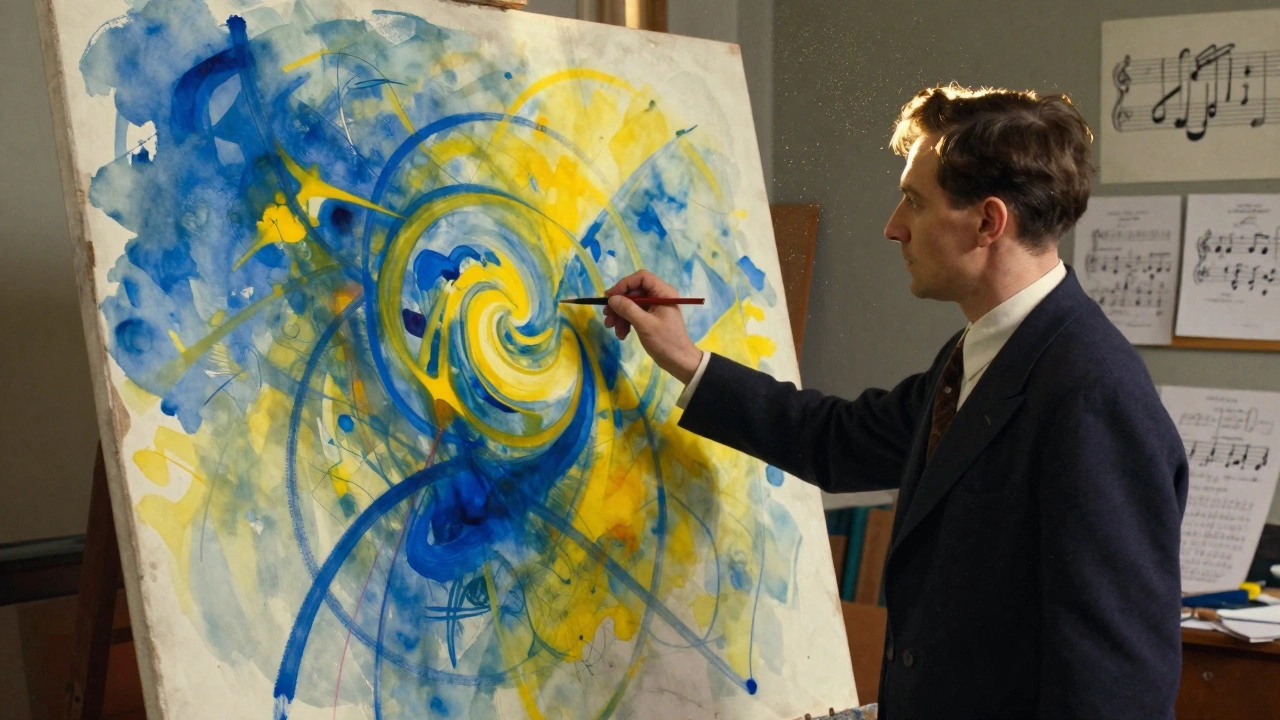
When people ask who made abstract art famous, the answer almost always starts with Wassily Kandinsky. A Russian painter and art theorist, Kandinsky created the first purely abstract painting in 1910. Kandinsky didn’t just paint abstractly-he wrote about it. His 1911 book, Concerning the Spiritual in Art, argued that color and shape could move the soul just like music. He compared a yellow triangle to a trumpet blast and a blue circle to a deep cello note.
Before Kandinsky, even artists experimenting with form still held onto recognizable subjects. He didn’t. His 1910 painting Untitled (First Abstract Watercolor) had no trees, no faces, no houses. Just lines, blobs, and washes of color. It was shocking. But it was also the moment abstract art became a serious movement. By 1913, he was leading the Blue Rider group in Germany, teaching others how to see art as emotion, not representation.
Piet Mondrian: Order in the Chaos
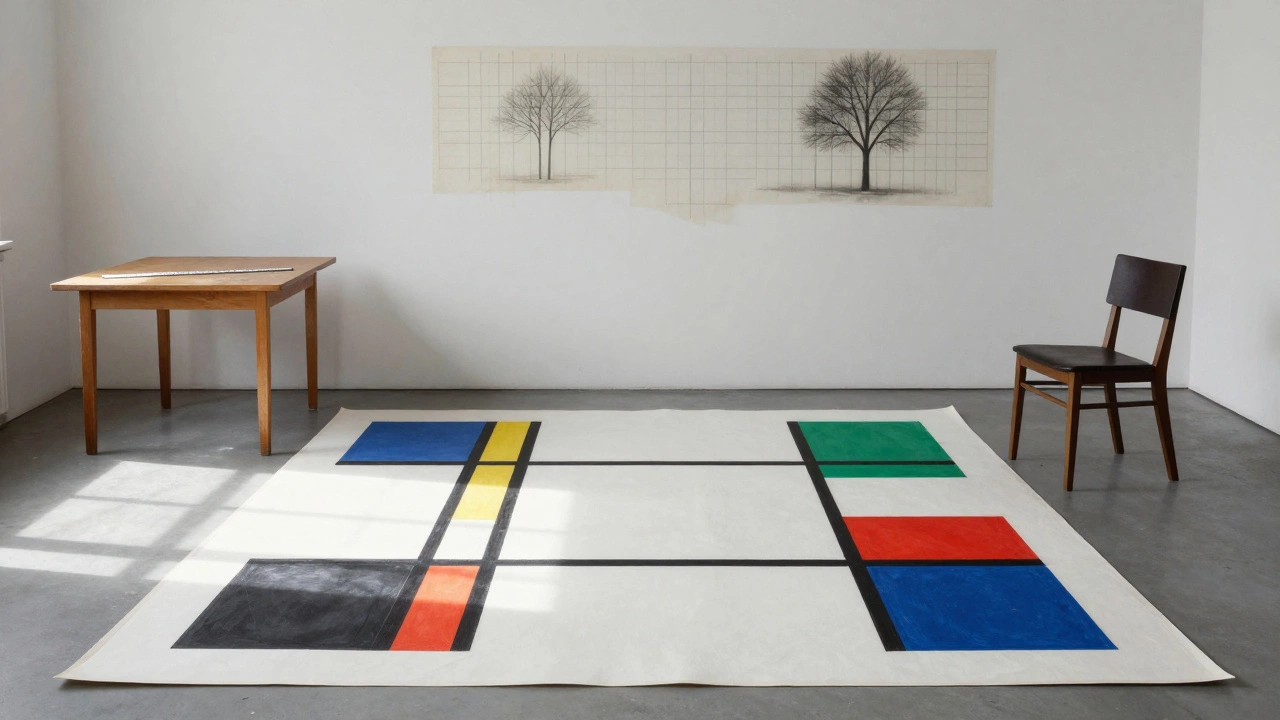
If Kandinsky was about feeling, Piet Mondrian. A Dutch painter who turned abstraction into a kind of visual math. Mondrian didn’t just remove objects-he stripped everything down to lines and primary colors. His famous grid paintings-black lines, red squares, blue rectangles, white backgrounds-look simple. But they were the result of years of reduction.
He started with trees. Then he simplified them. Then he removed the tree entirely. What remained was a structure: vertical and horizontal lines, perfect right angles, and three colors. He called it Neoplasticism. To Mondrian, this wasn’t decoration. It was a new kind of truth. He believed the world’s harmony could be expressed through pure form. His work became the foundation for modern design-from Bauhaus furniture to Apple’s minimalist interfaces.
Jackson Pollock: The Energy of Paint
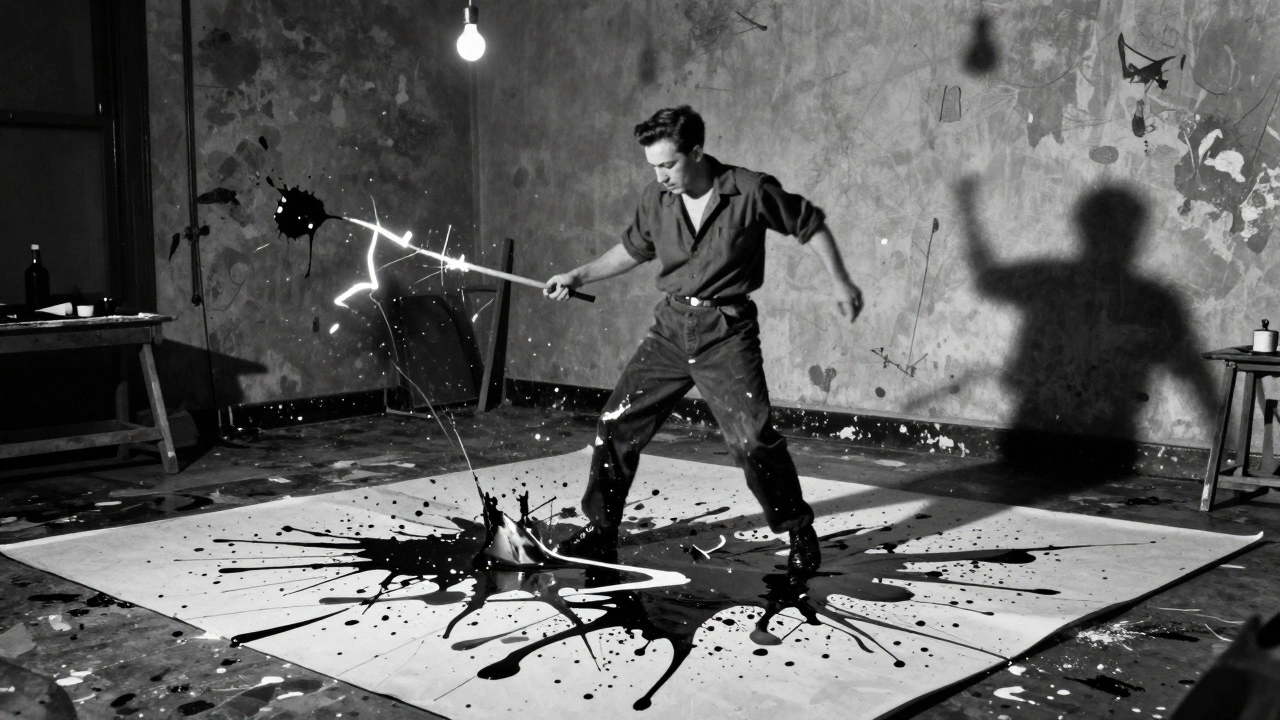
By the 1940s, abstract art had moved from Europe to New York. And no one pushed it further than Jackson Pollock. An American painter who turned painting into a physical act. Pollock didn’t use brushes. He poured, dripped, and flung paint onto canvases laid on the floor.
His 1950 work Number 1A, 1948 looks like a web of tangled threads. But it wasn’t random. He moved around the canvas like a dancer, letting his body guide the paint. Critics called it chaos. But art historian Harold Rosenberg called it Action Painting-a record of the artist’s energy in motion. Pollock’s work didn’t just show abstraction-it made you feel the force behind it. His fame exploded after a 1949 Life magazine cover asked, "Is he the greatest living painter in the United States?"
Other Key Figures Who Shaped the Movement
Kandinsky, Mondrian, and Pollock are the big three-but they didn’t do it alone.
- Kazimir Malevich. A Russian who painted the black square in 1915-just a black square on a white canvas. He called it Suprematism, and it was meant to represent pure feeling beyond objects.
- Mark Rothko. An American who painted giant rectangles of color that seemed to glow. His work wasn’t about shape-it was about mood. People have cried in front of his paintings.
- Hilma af Klint. A Swedish artist who made abstract paintings as early as 1906, years before Kandinsky. Her work was hidden for decades because she believed the world wasn’t ready. Today, she’s recognized as the true pioneer.
These artists didn’t just paint differently-they thought differently. They believed art could speak without words. That color could carry emotion. That a dot, a line, or a splash could hold meaning deeper than a portrait.
Why Did Abstract Art Catch On?
It wasn’t just talent. It was timing.
The early 1900s were a time of radical change. Photography replaced realistic painting. Science revealed invisible worlds-atoms, X-rays, electromagnetic waves. The world felt less solid. Artists responded by making art that wasn’t about what you saw-but what you felt.
Post-war America needed new symbols. Abstract art offered freedom. It didn’t tell stories. It didn’t obey rules. It was raw. Personal. Unfiltered. Museums started buying it. Collectors paid millions. By the 1950s, New York replaced Paris as the center of the art world-and abstract art led the way.
What Made These Artists Famous?
Fame didn’t come from galleries alone. It came from three things:
- Consistency-They didn’t make one abstract painting and stop. They spent decades refining their vision.
- Theory-They wrote, taught, and explained why their art mattered. Kandinsky’s books, Mondrian’s manifestos, Pollock’s interviews-they gave people language to understand it.
- Visibility-They showed in major exhibitions. The Museum of Modern Art in New York gave Kandinsky his first solo show in 1939. Pollock’s 1950s shows drew crowds and headlines.
They didn’t just make art. They changed how people thought about art.
Abstract Art Today
Today, abstract art isn’t just in museums. It’s on T-shirts, in apps, on album covers. It’s in the logos of tech companies and the wallpaper on your phone. The same principles-color, line, texture, emotion-are still at work.
Modern artists still build on what Kandinsky, Mondrian, and Pollock started. The difference? Now, people don’t laugh. They understand. Abstract art isn’t strange anymore. It’s one of the most influential movements in history.
Who was the first person to make abstract art?
Hilma af Klint made abstract paintings as early as 1906, before Kandinsky. But she kept them private, believing the world wasn’t ready. Wassily Kandinsky is credited as the first to publicly introduce and promote abstract art in 1910, making him the one who made it famous.
Why did people hate abstract art at first?
People expected art to show something real-a face, a landscape, a story. Abstract art didn’t. It looked messy, random, or like a child’s drawing. Critics called it lazy or fraudulent. But once viewers learned to see it as emotion rather than representation, the resistance faded.
Is abstract art still relevant today?
Absolutely. Modern design, branding, and digital interfaces rely on abstract principles-color psychology, geometric balance, visual rhythm. Artists like Yayoi Kusama and Mark Bradford continue the tradition. Abstract art isn’t a relic-it’s a language that keeps evolving.
Can anyone make abstract art?
Anyone can make a splash of paint. But what made Kandinsky, Mondrian, and Pollock great wasn’t just technique-it was intention. They had a philosophy. A reason. Abstract art isn’t about randomness. It’s about purposeful expression. That’s what separates it from decoration.
How much are abstract paintings worth today?
Top works sell for tens of millions. Kandinsky’s Studie für Improvisation 8 sold for $23 million in 2012. Pollock’s No. 5, 1948 went for $140 million in a private sale. Even Mondrian’s smaller grids now fetch over $50 million. Their value comes from influence, not just beauty.