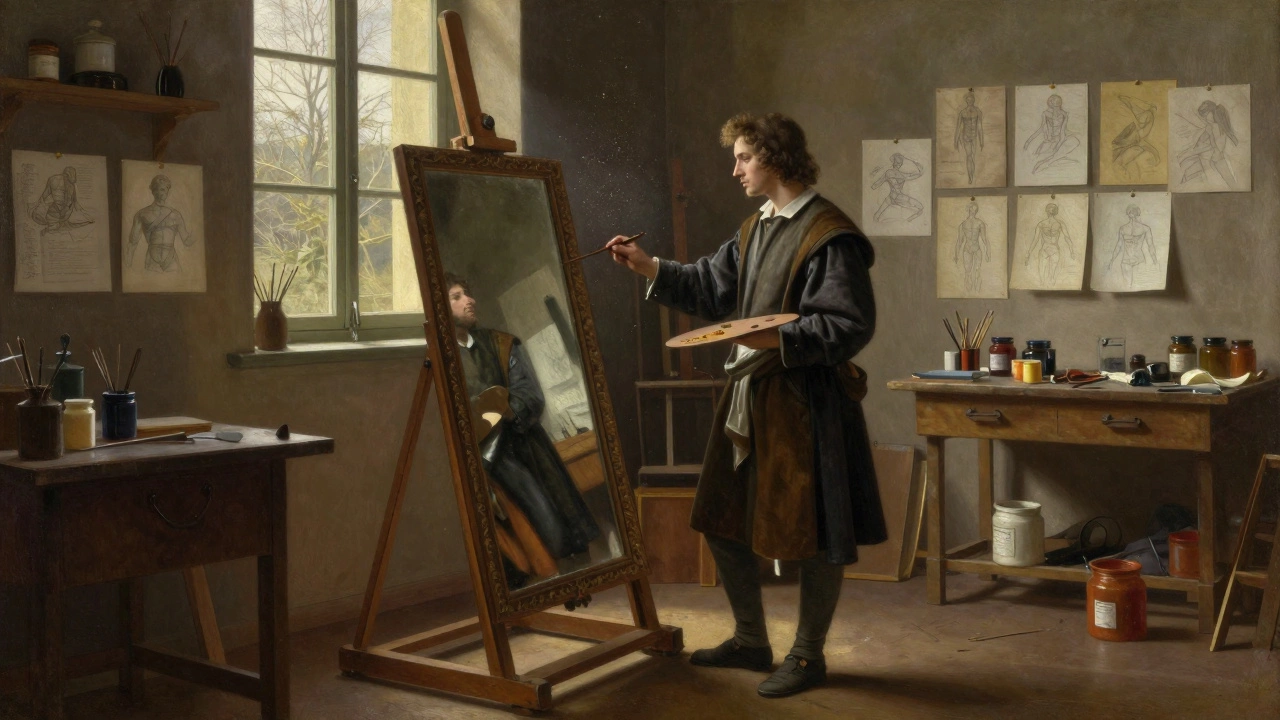
Self-Portrait Motivation Finder
Why do you want to paint yourself? Answer these three questions to discover which artistic tradition aligns with your intent.
Your Primary Motivation:
Historical Example:
Have you ever looked at a painting and realized the person staring back at you is the painter themselves? It’s a common sight in museums, from the intense gaze of Rembrandt to the playful distortion of Picasso. But why do artists spend hours mixing paints just to capture their own reflection? Is it vanity? Boredom? Or something deeper?
The short answer is yes, artists absolutely do self-portraits. In fact, self-portrait creation is one of the oldest and most consistent traditions in visual art. It’s not just about having a convenient model who never leaves; it’s a complex act of self-examination, technical practice, and sometimes, a desperate attempt to control how the world sees them.
The Practical Reasons: Convenience and Cost
Let’s start with the obvious. Hiring a professional model is expensive. If you’re an artist struggling to make rent, sitting in front of your own mirror for six hours a day costs nothing but time. This practical constraint has driven centuries of artistic output. When Leonardo da Vinci was young, he likely painted himself because he had no one else available or affordable. The result wasn’t just a snapshot; it was a study of light, shadow, and anatomy that he could control entirely.
Self-portraits also serve as a testing ground. An artist might want to try a new brush technique, a bold color palette, or a specific lighting setup. Using yourself allows for immediate feedback. You know exactly what your nose looks like, so if the painting doesn’t match your memory, you know the technique needs adjustment. It’s a low-stakes environment for high-risk experimentation.
- Cost Efficiency: No need to pay models or studio assistants for basic studies.
- Schedule Control: You can pause, resume, or change poses whenever you want.
- Anatomical Reference: Your own body is always available for checking proportions and muscle structure.
Psychological Exploration: Who Am I?
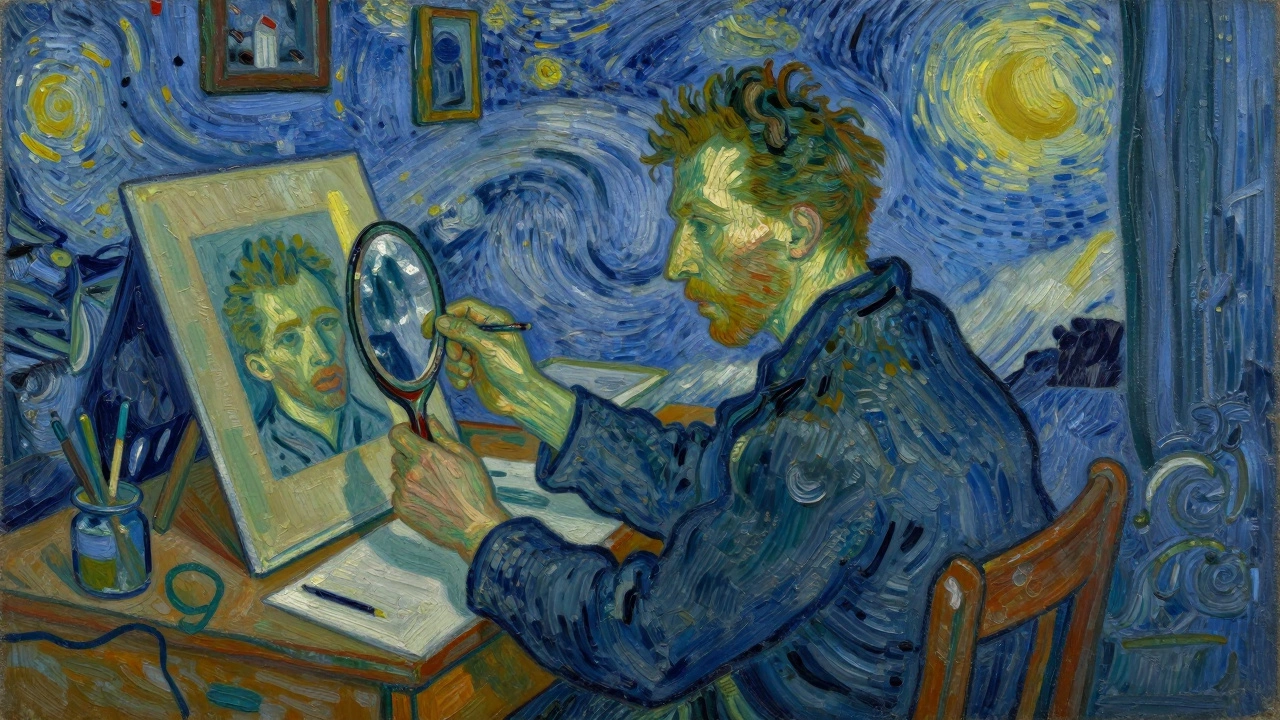
Beyond the wallet-friendly aspects, self-portraiture is deeply psychological. Art historian Tamar Garb argues that self-portraits are less about "looking like" someone and more about "being" someone. They are constructed identities. When Vincent van Gogh painted his famous series of self-portraits in Arles, he wasn’t just documenting his appearance. He was exploring his mental state, his relationship with nature, and his place in the art world. Each brushstroke was a question: "Who am I today?"
This introspection often leads to raw vulnerability. Frida Kahlo used her self-portraits to process physical pain and emotional trauma after a severe bus accident. Her paintings are filled with symbols-monkeys, roots, thorns-that reveal her inner life far more than a standard photograph could. For Kahlo, the canvas was a diary. By painting herself, she took ownership of her narrative, refusing to be defined solely by her suffering or her marriage to Diego Rivera.
Did Frida Kahlo only paint herself?
No, while she is famous for self-portraits, Kahlo also painted portraits of others, still lifes, and symbolic scenes. However, she famously said, "I paint myself because I am so often alone," highlighting the personal nature of her work.
Technical Mastery and Anatomical Study
For many artists, especially during the Renaissance and Baroque periods, painting oneself was a way to demonstrate skill. To paint another person accurately requires understanding human anatomy. To paint yourself requires that same knowledge plus the ability to observe subtle expressions and textures up close. Albrecht Dürer, a German master of the early 16th century, created highly detailed woodcuts and engravings of himself. These weren’t just selfies; they were declarations of his status as a serious intellectual and artist, rivaling the greats of antiquity.
Consider the challenge of painting eyes. The iris, the pupil, the reflection of light-it’s incredibly difficult to get right. By studying their own eyes in the mirror, artists like Rembrandt perfected the technique of capturing depth and emotion. Rembrandt’s later self-portraits show a man aging, with heavy eyelids and deep lines. He didn’t hide these flaws; he studied them. This level of detail required immense technical prowess, proving that the artist could handle the most complex subject: the human face.
Controlling the Narrative: Brand Building
In the modern era, self-portraits have become a form of branding. Before social media, artists needed to create a recognizable image. Andy Warhol understood this intuitively. His self-portraits, often featuring him in sunglasses or with distinct hair, became icons. They were cool, detached, and mysterious. Warhol wasn’t just painting his face; he was designing the logo for "Andy Warhol."
This trend continues today. Contemporary artists use self-portraiture to comment on fame, gender, and race. Kehinde Wiley paints himself (and others) in the grand style of Old Master portraits, placing Black subjects in positions of power and elegance traditionally reserved for European royalty. By inserting himself into this historical context, Wiley challenges the viewer’s expectations and reclaims space in art history. It’s a powerful statement that goes beyond aesthetics.
| Era | Primary Motivation | Key Example |
|---|---|---|
| Renaissance | Technical demonstration & status | Albrecht Dürer |
| Baroque | Emotional depth & realism | Rembrandt van Rijn |
| Modernism | Psychological exploration | Vincent van Gogh |
| Contemporary | Identity politics & branding | Kehinde Wiley / Cindy Sherman |
The Mirror vs. The Camera
How do artists actually create these images? Historically, mirrors were the primary tool. Painting from a mirror reverses your image, which can be disorienting. Many artists report that their self-portraits look slightly "wrong" because they are used to seeing their reversed reflection. This cognitive dissonance adds a layer of complexity to the process.
With the invention of photography, the dynamic changed. Early photographers like Julia Margaret Cameron used cameras to create self-portraits that felt intimate and ethereal. Today, digital tools allow for even greater manipulation. Some contemporary artists use AI or photo-editing software to distort their features, questioning what is "real" in the age of filters. The medium changes, but the core intent remains: to present a curated version of the self.
Common Myths About Self-Portraits
There are several misconceptions about why artists paint themselves. Let’s clear them up.
- Myth: It’s just vanity. While some self-portraits are flattering, many are brutally honest. Van Gogh’s gaunt faces or Kahlo’s exposed organs are not acts of narcissism; they are acts of survival and truth-telling.
- Myth: Only painters do it. Photographers, sculptors, and digital artists all create self-portraits. Cindy Sherman, for instance, uses photography to perform different roles, challenging stereotypes about women.
- Myth: It’s easy. Capturing your own likeness is harder than it sounds. You’re both the creator and the subject, which creates a split focus. Maintaining eye contact with a mirror while looking at the canvas requires significant concentration and spatial awareness.
How to Start Your Own Self-Portrait Practice
If you’re inspired to try this yourself, here’s a simple guide to getting started without feeling overwhelmed.
1. Set Up Your Space: Place a large mirror where you usually work. Ensure good, natural lighting. Harsh shadows can make details hard to see, so diffuse the light if possible.
2. Choose Your Medium: Charcoal is forgiving and great for beginners because it’s easy to erase. Oil paint allows for blending and texture, but it takes longer to dry. Acrylic is fast-drying and versatile.
3. Focus on Structure First: Don’t jump into details. Sketch the basic shapes of your head, jawline, and eyes. Get the proportions right before adding color or shading.
4. Embrace Imperfection: Your first self-portrait won’t look exactly like you. That’s okay. The goal is to learn about observation and expression, not to create a perfect copy.
Is it strange to paint yourself?
Not at all. It’s a historic and respected tradition. Many artists find it liberating to explore their own image without the pressure of pleasing a client or model.
What is the difference between a selfie and a self-portrait?
A selfie is typically a quick snapshot for documentation or social sharing. A self-portrait is a deliberate artistic creation, often involving composition, symbolism, and technical skill to convey a deeper meaning or emotion.
Can I use a photo reference for a self-portrait?
Yes, many artists use photos as references. However, working directly from a mirror or live observation helps improve your drawing skills and captures more dynamic expressions.
Why did Rembrandt paint so many self-portraits?
Rembrandt painted over 40 self-portraits throughout his life. He used them to study aging, emotion, and light. They serve as a visual diary of his life, showing his evolution from a confident young man to a weary, reflective elder.
Do female artists do self-portraits differently than male artists?
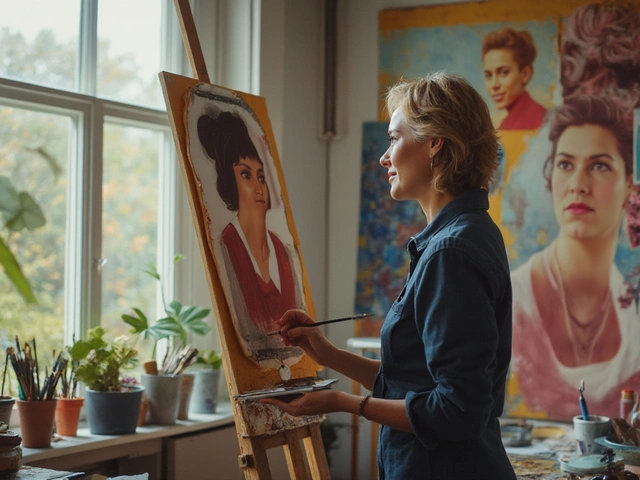
Historically, yes. Female artists often used self-portraits to assert their professional status in a male-dominated field. Artists like Artemisia Gentileschi and Sofonisba Anguissola depicted themselves at work, holding brushes or palettes, to prove they were serious practitioners, not just muses.
So, do artists do self-portraits? Yes, and they will continue to do so. Whether for money, mastery, or meaning, the act of painting oneself remains a powerful way to connect with the world. Next time you see a self-portrait, look closer. You’re not just seeing a face; you’re seeing a story.