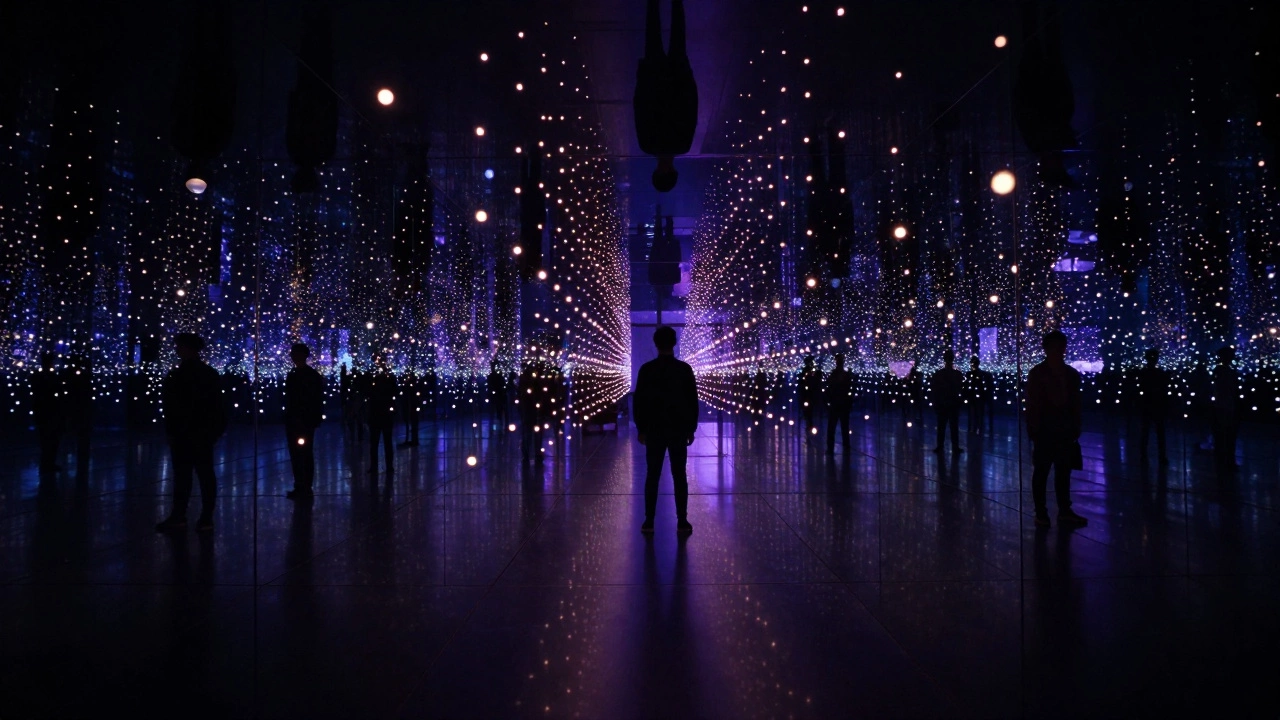
Contemporary art isn’t just what’s new-it’s art that speaks to now. It asks questions, challenges norms, and often makes you feel something before you understand why. If you’ve ever stood in front of a room full of blinking lights or a field of polka-dotted pumpkins and felt confused, amazed, or even a little uneasy, you’ve experienced contemporary art.
One Powerful Example: Yayoi Kusama’s Infinity Mirrors
One of the most recognizable examples of contemporary art is Yayoi Kusama’s Infinity Mirrored Rooms. These are small, enclosed spaces lined with mirrors and filled with hanging LED lights that seem to stretch into infinite space. Visitors step inside for just 30 seconds, often holding their breath, as the lights multiply around them-creating the feeling of floating in a galaxy, or maybe dissolving into nothing.
Kusama, born in Japan in 1929, has been making this kind of work since the 1960s. She didn’t wait for permission. She didn’t follow trends. She made art because she had to. As a child, she experienced hallucinations of dots covering walls, floors, even people. She called them "self-obliteration." Instead of hiding it, she turned it into art. Her dots, her mirrors, her pumpkins-they’re not decorations. They’re her way of surviving.
Her 2017 installation Infinity Mirrored Room-The Souls of Millions of Light Years Away became a global sensation. Lines stretched around museums in Washington, Toronto, and Los Angeles. People waited hours just to get inside. Social media exploded with photos. But here’s the thing: no photo captures it. You have to be there. The art isn’t the picture. It’s the experience.
Why This Counts as Contemporary Art
Contemporary art doesn’t need to be painted on canvas or carved from marble. It doesn’t need to be beautiful in the traditional sense. It needs to be present. It needs to react to the world we live in now-technology, identity, mental health, isolation, connection.
Kusama’s work does all of that. The mirrors reflect not just light, but the viewer. You become part of the art. You’re not just looking-you’re inside it. And in a world where we’re constantly scrolling, posting, performing for others, her rooms force you to stop. To be still. To feel small. To feel alone. And strangely, to feel connected.
Unlike modern art, which mostly ended around the 1970s with movements like Abstract Expressionism or Pop Art, contemporary art has no single style. It’s messy. It’s loud. It’s quiet. It’s digital, performative, political, or personal. Kusama’s rooms are contemporary because they were made now, by an artist still alive and active, and they speak to how we live today.
Other Artists Shaping Contemporary Art Today
Kusama isn’t the only one. Contemporary art is full of voices pushing boundaries:
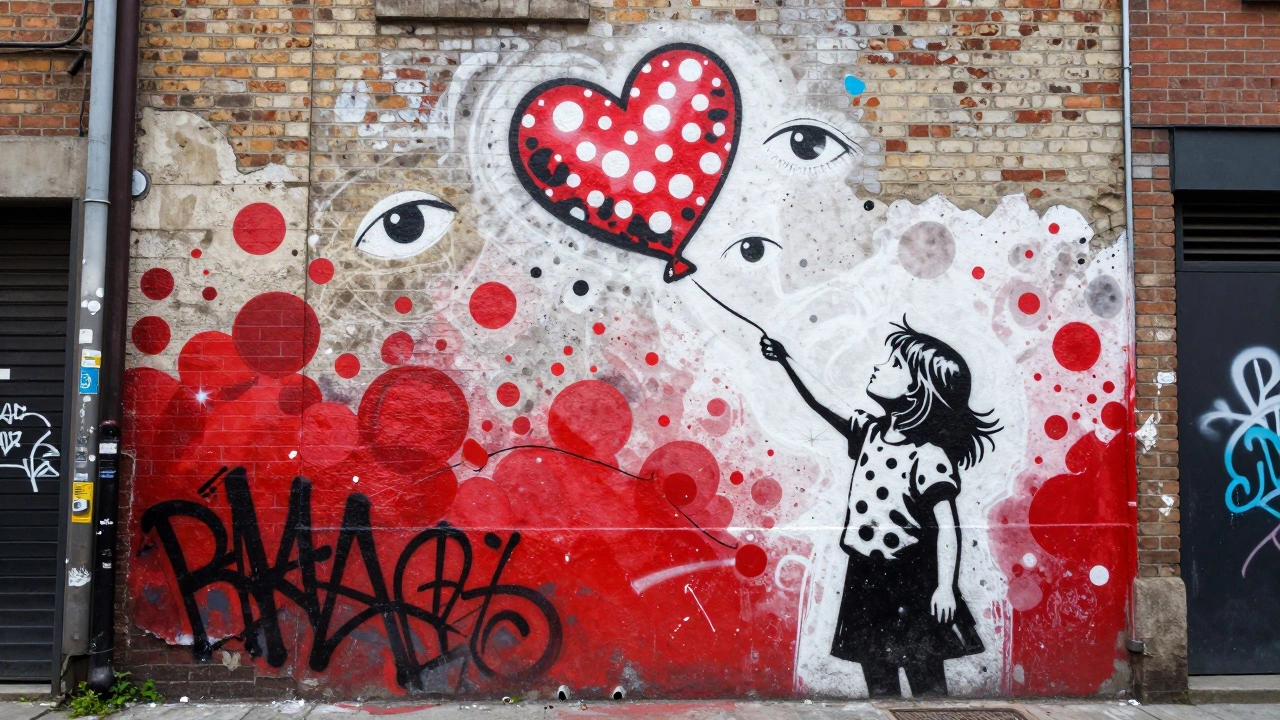
- Banksy-anonymous street artist whose satirical stencils critique war, consumerism, and authority. His shredded painting at Sotheby’s in 2018 wasn’t vandalism-it was performance art.
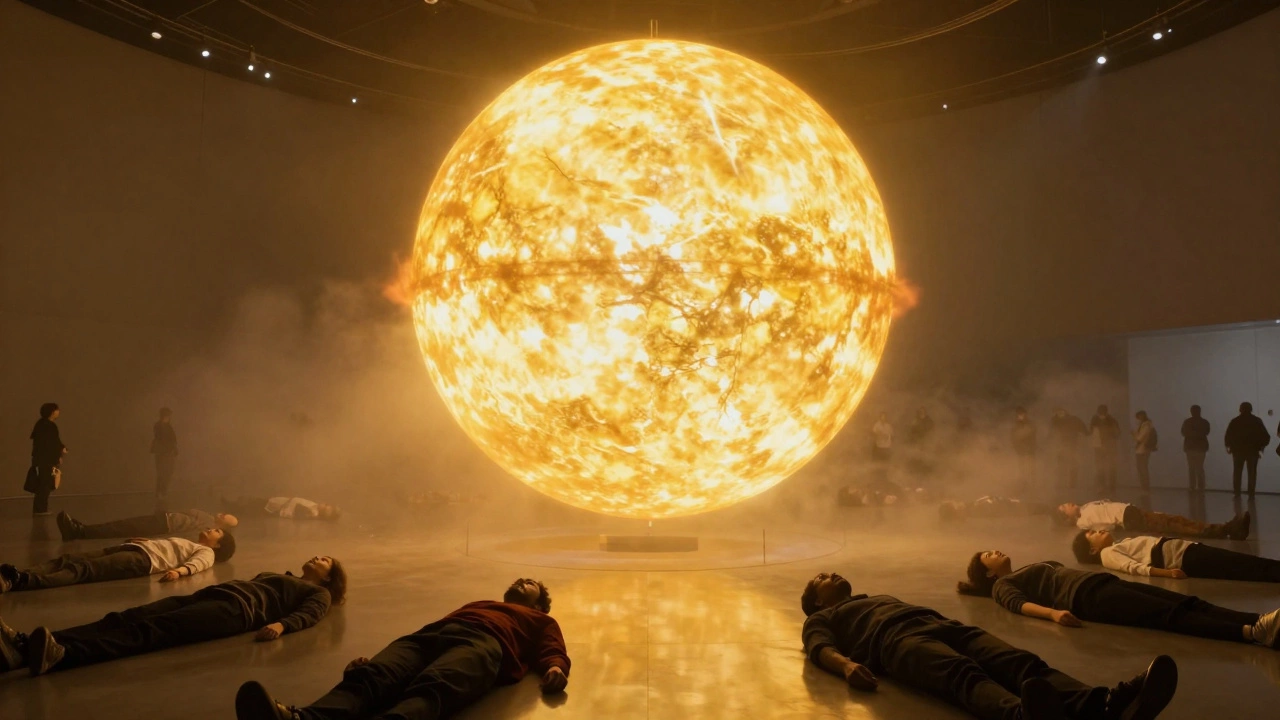
- Olafur Eliasson-creates immersive environments using light, water, and fog. His Weather Project at Tate Modern turned the museum’s hall into a glowing sun, making visitors lie on the floor and stare up.
- Barbara Kruger-uses bold red, white, and black text over photos to question power, gender, and desire. Her work looks like advertising, but it’s asking you to question who’s pulling the strings.
- Julie Mehretu-paints massive, layered abstract canvases that map cities, protests, and migration. Her work feels like history moving at warp speed.
These artists don’t just make objects. They make situations. They create moments that stick with you long after you leave the gallery.
What Makes Contemporary Art Different from Modern Art?
People mix up "modern" and "contemporary" all the time. But they’re not the same.
Modern art covers the period from the 1860s to the 1970s. Think Picasso, Matisse, Mondrian. It was about breaking rules-rejecting realism, experimenting with form, exploring the subconscious. It was often made by white male artists in Europe and the U.S.
Contemporary art starts around the 1970s and continues today. It’s global, diverse, and often political. It includes artists from Africa, Asia, Latin America, Indigenous communities. It uses video, sound, social media, even AI. It’s not just about what something looks like-it’s about what it means, who made it, and who gets to see it.
Kusama’s work bridges both worlds. She started in the modern era, but her impact is entirely contemporary. She’s not just an artist-she’s a cultural force.
Is Contemporary Art Just for the Elite?
Some say it’s pretentious. That you need a degree to "get" it. But that’s not true. You don’t need to know art history to feel something in Kusama’s mirror room. You don’t need to read a wall label to be moved by Banksy’s girl with a balloon.
Contemporary art isn’t about being smart. It’s about being open. It’s okay if you don’t understand it. The point isn’t to decode it. The point is to notice how it makes you feel. Confused? Good. Curious? Better. Angry? That’s fine too.
Many of these works are free to see. Public galleries, street art, even Instagram accounts of artists like Kusama or Ai Weiwei bring contemporary art to your phone. You don’t need to pay $25 for a ticket to feel it.
Where to See Contemporary Art Near You
Contemporary art isn’t locked away in New York or London. It’s in small galleries, university art centers, even pop-up installations in parking lots. In Wellington, where I live, the City Gallery and the Adam Art Gallery regularly feature new work from Pacific and Asian artists. In Auckland, the Auckland Art Gallery has a whole floor dedicated to contemporary New Zealand and global artists.
Look for local biennials, art walks, or open studios. Follow artists on Instagram. Visit public spaces-murals, sculptures, digital projections. Contemporary art isn’t always inside a white cube. Sometimes, it’s on the side of a bus shelter.
Why This Matters
Contemporary art doesn’t just hang on walls. It reflects who we are-our fears, our joys, our contradictions. In a time of climate anxiety, political division, and digital overload, artists like Kusama give us a space to pause. To feel. To remember we’re human.
You don’t have to love every piece. You don’t have to buy it. But if you let it in-even for 30 seconds-you might find something you didn’t know you were missing.
What makes art "contemporary"?
Art is considered contemporary if it was made after the 1970s and reflects current ideas, technologies, or social issues. The artist is usually still alive, and the work responds to the world as it is today-not as it was in the past.
Is Yayoi Kusama the most famous contemporary artist?
She’s one of the most widely recognized, especially because of her immersive installations. But "famous" doesn’t mean "most important." Artists like Kara Walker, Ai Weiwei, and Cai Guo-Qiang have equally powerful impacts, though their work is less viral. Fame often comes from media attention, not artistic value.
Can I make contemporary art without training?
Absolutely. Contemporary art values idea over technique. A photograph of a protest, a video of your daily routine, a sculpture made from trash-these can all be contemporary art if they express something true about now. Many artists started with no formal training.
Why do some contemporary artworks cost millions?
Price often reflects market demand, the artist’s reputation, and institutional validation-not just the cost of materials. A Banksy can sell for $1 million because it’s rare, culturally significant, and backed by collectors and museums. But most contemporary art is affordable, and much of it is free to experience.
Is digital art considered contemporary art?
Yes. Digital art, NFTs, AI-generated images, and interactive installations are all part of contemporary art today. Artists like Refik Anadol use data and machine learning to create living, breathing visuals. The medium changes, but the goal stays the same: to make you think and feel.