Oil Painting Canvas Selection Guide
Find Your Perfect Canvas
Answer a few questions to get personalized recommendations for your oil painting project.
Practice & studies
Serious work
Gallery-ready
Sketches, studies
Under 24x30 inches
Over 30x40 inches
Museum-quality
Classic look
Rigid surface
Hybrid approach
$5-$15
$15-$40
$40+$
Choosing the right canvas for oil painting isn’t just about what looks nice on the shelf-it affects how the paint behaves, how long your artwork lasts, and even how much you enjoy the process. If you’ve ever had paint sink into the fabric, crack after a few months, or peel off the surface, you already know the wrong canvas can ruin a good idea.
Why the canvas matters more than you think
Oil paint is thick, slow-drying, and heavy. It doesn’t just sit on top of a surface-it sinks in, bonds with fibers, and expands and contracts as it cures. A weak or poorly prepared canvas will warp, sag, or crack under that weight. That’s why professionals don’t just grab the cheapest option. They pick based on fiber type, weave tightness, weight, and how it’s primed.
Think of the canvas as the foundation of your painting. If it’s unstable, everything else built on top will be too. Even the most brilliant brushwork can’t save a painting that’s falling apart because the canvas was too thin or improperly stretched.
Linen vs. cotton: the core difference
The two main materials for oil painting canvases are linen and cotton. They’re not interchangeable. Each has strengths and weaknesses.
Linen comes from flax plants. It’s stronger, more durable, and has a tighter, more uniform weave than cotton. Linen fibers are longer and less prone to stretching over time. That means your painting stays flat, even after decades. It’s also less likely to absorb oil from the paint, which helps preserve color intensity.
Professional artists, especially those working on large or long-term pieces, almost always choose linen. Museums hold centuries-old oil paintings on linen because it lasts. Brands like Fredrix and Winsor & Newton offer linen canvases that are archival-grade and pre-stretched.
Cotton is cheaper and more widely available. It’s softer, easier to stretch, and works well for students, sketches, or smaller works. But cotton fibers are shorter and more elastic. Over time, especially with temperature changes, cotton can stretch unevenly. That leads to sagging, cracking in the paint layer, or even warping of the wooden stretcher bars.
Don’t dismiss cotton entirely-it’s perfectly fine for practice, studies, or pieces you don’t plan to sell or preserve for generations. But if you’re making something meant to last, linen is the only real choice.
Weight and weave: what to look for
Not all linen or cotton canvases are the same. The key is in the weight and weave.
Weight is measured in ounces per square yard (oz/yd²). For oil painting, aim for at least 10 oz/yd². Heavier weights-12 to 15 oz/yd²-are better for large canvases or heavy impasto work. Thin canvases (under 8 oz) will buckle under thick paint and are prone to tearing during stretching.
Weave refers to how tightly the threads are woven. There are three common types:
- Smooth (fine weave): Good for detailed work, portraits, and fine brushwork. The texture doesn’t interfere with delicate lines.
- Medium weave: The most popular choice. Offers a little tooth for paint to grip without overwhelming the surface. Works for most styles.
- Coarse (rough weave): Adds texture and energy. Great for expressive, abstract, or impasto painting. But it can make fine details hard to control.
Most artists start with medium weave. It’s versatile and forgiving. You can always experiment with rougher weaves once you know how your brush handles texture.
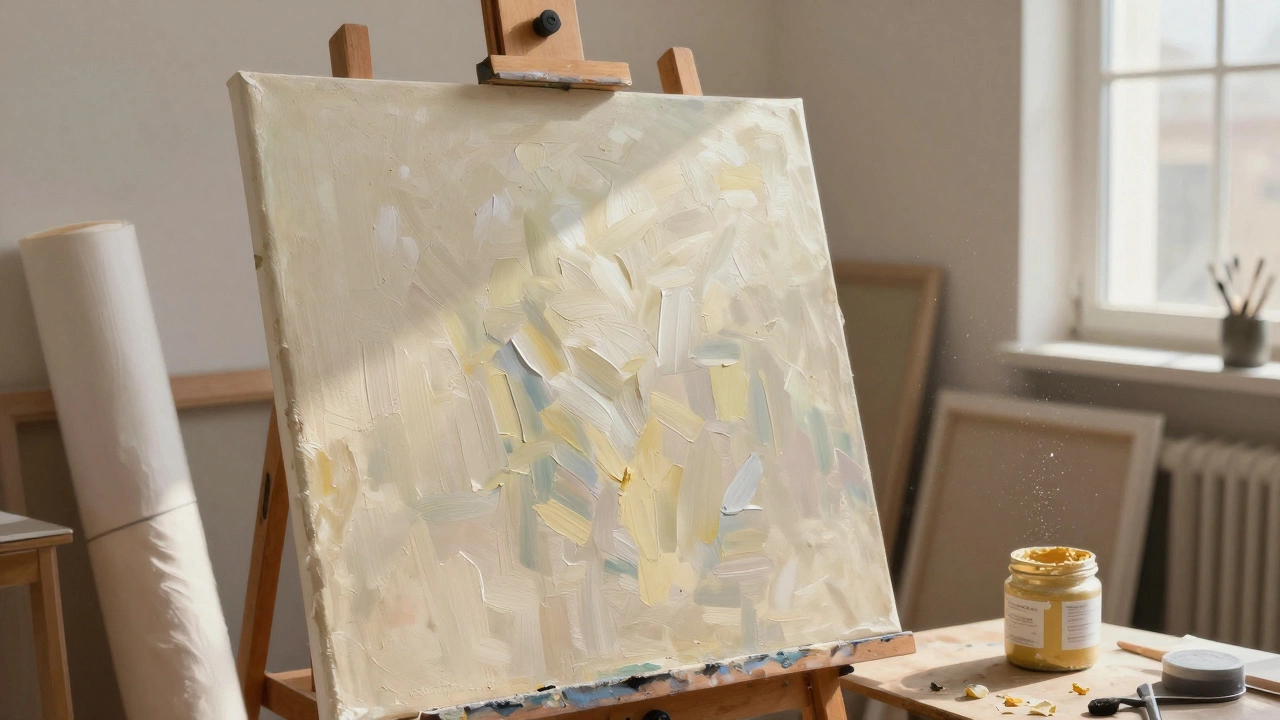
Priming: the invisible protector
Raw canvas is not paint-ready. Oil will eat into unprimed fabric, weakening it over time and causing yellowing or rot. That’s why priming is non-negotiable.
The standard primer is acrylic gesso. It’s flexible, dries fast, and creates a slightly textured surface that holds paint well. Most pre-stretched canvases come with one or two coats. But for oil painting, you need more.
Professional artists often apply three to four coats of gesso, sanding lightly between layers. This creates a smooth, sealed surface that protects the fabric and gives consistent paint behavior. Some even use oil-based primers like lead white or titanium white in linseed oil. These are traditional, more archival, and offer a slightly different tooth-but they take days to dry and require solvents.
Watch out for cheap canvases with only one thin coat of gesso. You’ll see the fabric showing through, or the paint sinking in unevenly. That’s a red flag.
Stretched vs. panel: what’s better?
Most people think of stretched canvas when they imagine oil painting. But rigid panels-wood, MDF, or aluminum-are gaining popularity.
Stretched canvas is flexible. It’s portable, easy to store, and gives that classic look. But it can sag over time, especially on large sizes. You need to stretch it properly and keep it away from humidity.
Wood panels are rigid. They don’t flex. That means no sagging, no cracking from movement. They’re ideal for thick paint, detailed work, or pieces you want to hang without a frame. Many artists prime panels with multiple layers of gesso and sand them to a glass-smooth finish. They’re heavier and less portable, but they last longer.
Some artists use both: start with a panel for underpainting, then transfer to canvas for the final layer. Others stick to one. It’s about your workflow.
What to buy if you’re serious
Here’s a simple guide based on your goals:
- Beginner / practice: Medium-weight cotton canvas, pre-primed with two coats of acrylic gesso. Buy in bulk. It’s affordable and lets you experiment.
- Intermediate / serious work: Medium-weight linen, triple-primed with acrylic gesso. Look for brands like Fredrix, Canvasworks, or Art Alternatives. These are archival and reliable.
- Professional / gallery-ready: Heavyweight linen (14+ oz/yd²), hand-primed with oil-based ground or four coats of acrylic gesso. Stretch it yourself on kiln-dried pine stretchers. This is how museum-quality pieces are made.
Don’t buy canvas from discount stores unless you’re just doodling. You’ll waste time and paint. A $5 canvas that cracks after six months costs more in the long run than a $25 one that lasts 50 years.
How to test a canvas before buying
Before you commit, check a few things:
- Hold it up to the light. If you can see the fabric weave clearly through the gesso, it’s under-primed.
- Tap the surface. A hollow sound means it’s stretched tightly. A dull thud means it’s loose.
- Run your fingers over it. It should feel smooth but slightly gritty-not slippery or overly sticky.
- Check the stretcher bars. They should be solid wood, not flimsy particle board. Look for keying corners that allow you to tighten the canvas later.
If it passes these checks, it’s likely good enough to work with.
Common mistakes to avoid
- Using unprimed canvas. Oil will rot the fabric. Always prime.
- Buying ultra-cheap canvases labeled "artist grade"-they’re often student grade with thin gesso.
- Stretching canvas too loosely. It will sag and warp.
- Using house paint or wall primer. It’s not flexible enough and will crack.
- Assuming all "linen" is equal. Some are cotton-linen blends. Check the label.
One artist I know painted a large landscape on a $12 canvas from a craft store. Three years later, the paint cracked in long lines. The canvas had stretched unevenly. He had to re-stretch it, and the paint peeled off in places. He now buys only triple-primed linen. It cost him more upfront-but he doesn’t have to repaint anything.
Final thought: Invest in your foundation
Oil painting is a slow, layered process. You spend hours building up glazes, scraping back, reworking. Your canvas should be the silent partner that supports all that effort-not the weak link that breaks under pressure.
Linen, properly primed and stretched, is the gold standard. Cotton works for learning. But if you care about your art lasting, don’t cut corners on the surface it’s built on. Your future self-and anyone who sees your work-will thank you.
Can I use canvas that’s already painted on?
Yes, but only if the previous paint is fully cured and stable. Sand the surface lightly to create tooth, then apply at least two coats of acrylic gesso over the old paint. This seals it and creates a fresh, neutral base. Never paint oil over oil unless you’re certain the underlying layer is dry-this can cause cracking or peeling.
Is priming necessary for oil paint?
Absolutely. Oil paint contains linseed oil, which eats into raw fabric over time, causing it to rot, yellow, and weaken. Priming with gesso creates a barrier that protects the canvas and gives the paint a consistent surface to adhere to. Skipping this step will shorten the life of your painting dramatically.
What’s the difference between acrylic gesso and oil primer?
Acrylic gesso dries quickly, is water-based, and flexible-ideal for most modern oil painters. Oil primer, made with lead or titanium white in linseed oil, dries slowly and creates a harder, more traditional surface. It’s more archival and preferred by some classical painters, but requires solvents and longer drying times. Most artists today use acrylic gesso for its ease and reliability.
Can I use canvas boards for oil painting?
Yes, but only if they’re specifically made for oil. Many canvas boards are glued to cardboard and aren’t designed for heavy paint or long-term storage. Look for boards with thick, archival-grade canvas and rigid backing. They’re great for studies or plein air work, but not for large or permanent pieces.
How do I know if a canvas is archival?
Check the label for terms like "archival," "museum-grade," or "100% linen." Avoid blends like "linen-cotton" unless specified as high-quality. The stretcher bars should be kiln-dried hardwood, not softwood or particle board. Reputable brands like Fredrix, Art Alternatives, and Masterpiece list their materials clearly. If the packaging doesn’t say, assume it’s not archival.