Music Streaming Service Finder
Answer these questions to find out which streaming platform aligns best with your lifestyle in 2026.
1. Which device do you use most often?
2. How important is high-fidelity (Lossless/Hi-Fi) audio to you?
3. What is your primary goal when listening?
4. Do you already pay for other services that might bundle music?
Your Recommended Service
Spotify
Based on your answers...
Why this choice?
Remember when switching from CDs to MP3s felt like a revolution? Fast forward to 2026, and we’re drowning in choice. You open your phone, tap an icon, and suddenly you have access to over 100 million songs. But with Spotify holding nearly 40% of the global market, is it actually the best option for you, or are you just paying for brand recognition?
I’ve been testing every major platform this month here in Wellington, comparing them on audio quality, discovery algorithms, and that crucial factor: how well they handle my spotty internet connection during stormy weather. The answer isn’t simple because "best" depends entirely on what you value. Do you care about high-fidelity lossless audio? Or do you just want to find new indie bands without thinking? Let’s break down who actually wins in 2026.
The Algorithm Battle: Discovery vs. Library Depth
If you listen to the same 50 artists on repeat, any service works. But if you want to discover new music, Spotify’s recommendation engine remains the industry gold standard. It’s not magic; it’s data. Spotify analyzes billions of playlists and listening habits to predict what you’ll like next. Their "Discover Weekly" feature still feels eerily accurate, often surfacing tracks I didn’t know existed but instantly loved.
Apple Music, on the other hand, leans heavily into human curation mixed with algorithmic suggestions. Since integrating more AI features in late 2025, its recommendations have improved significantly, especially for mainstream pop and hip-hop. However, many users still find Spotify’s "Daily Mixes" more personalized for niche genres like lo-fi beats or local New Zealand alternative rock.
Here’s the catch: Spotify’s strength is also its weakness. Because it pushes so much content at you, it can create a filter bubble. If you only listen to one genre, you might never hear anything else. Apple Music tends to be broader in its initial suggestions, which can be refreshing if you’re feeling adventurous.
Audio Quality: Does Hi-Fi Actually Matter?
In 2026, lossless audio is no longer a premium perk-it’s the baseline expectation. Tidal pioneered this space, but now most competitors offer CD-quality (16-bit/44.1 kHz) streams by default. Spotify launched their long-awaited HiFi tier in 2023, and by 2026, it has matured. They use FLAC encoding, which preserves all the details of the original recording without the massive file sizes of uncompressed WAV files.
But let’s be real: Can you actually hear the difference? On cheap Bluetooth earbuds, probably not. The compression used by Bluetooth codecs like SBC or even AAC strips away too much data before it hits your ears. To truly appreciate lossless audio, you need wired headphones or high-end wireless ones supporting LDAC or aptX Lossless codecs.
| Service | Standard Quality | Hi-Fi/Lossless | Spatial Audio |
|---|---|---|---|
| Spotify | Up to 320 kbps (AAC/Ogg) | FLAC 16-bit/44.1 kHz | Dolby Atmos (limited catalog) |
| Apple Music | AAC 256 kbps | ALAC up to 24-bit/192 kHz | Dolby Atmos & Spatial Audio |
| Tidal | MQA (deprecated)/FLAC | FLAC up to 24-bit/192 kHz | Dolby Atmos & Sony 360 Reality Audio |
| Amazon Music | HD (up to 850 kbps) | Ultra HD (up to 3730 kbps) | Dolby Atmos |
Apple Music currently offers the highest technical specifications, supporting up to 24-bit/192 kHz ALAC files. If you’re an audiophile with a dedicated DAC (Digital-to-Analog Converter), Apple Music gives you the most headroom. Spotify’s HiFi is good-very good-but it caps at CD quality. For 95% of listeners, Spotify’s quality is indistinguishable from Apple’s. But for that critical 5%, Apple takes the crown.
Ecosystem Integration: iPhone vs. Android vs. Everything Else
Your phone dictates your experience more than you think. If you live inside the Apple ecosystem-iPhone, Mac, Apple Watch, HomePod-Apple Music is practically free to switch to. The integration is seamless. Siri controls work flawlessly. Lyrics sync perfectly in real-time. And if you use AirPods Pro, the spatial audio tracking with head movement is a gimmick that surprisingly grows on you.
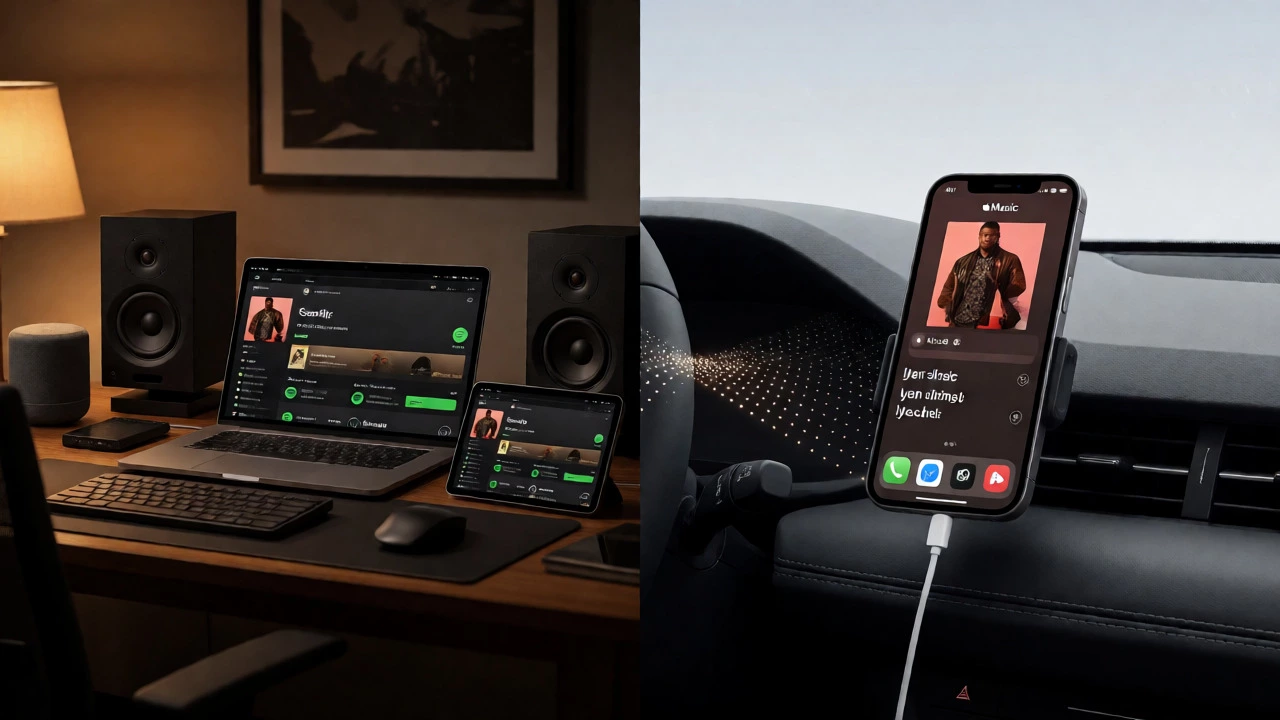
Spotify is the king of cross-platform compatibility. Whether you’re on an old Android phone, a Windows PC, a PlayStation, or even a smart fridge, Spotify works. It doesn’t force you into a specific hardware purchase. This flexibility is huge for people who upgrade phones frequently or use multiple devices daily. I personally use Spotify on my desktop for work and Apple Music on my commute because the car stereo integrates better with CarPlay.
Android users have a slight edge with Spotify due to deeper widget customization and notification controls. However, since Android 15 rolled out, Google has improved media control consistency across apps, narrowing that gap.
Pricing and Hidden Costs in 2026
Let’s talk money. Prices haven’t changed dramatically since 2024, but bundles have become the norm. Here’s what you’re looking at per month in NZD:
- Spotify Premium: ~$12.99/month. Includes ad-free listening, offline downloads, and HiFi.
- Apple Music: ~$12.99/month. Often bundled with iCloud+ storage plans, making it effectively cheaper if you already pay for cloud backup.
- Tidal: ~$10.99/month for HiFi Plus. No ads, full lossless library.
- Amazon Music Unlimited: ~$11.99/month for non-Prime members; included with Prime Video subscriptions in some regions.
The hidden cost? Data usage. Streaming lossless audio eats up data fast. A single hour of 24-bit/192 kHz streaming can consume over 1GB of data. If you’re on a capped mobile plan, sticking to standard quality (around 100MB/hour) saves you significant cash. Always check your app settings to ensure you’re not accidentally streaming Hi-Fi over cellular data unless you have unlimited plans.
Exclusive Content and Podcasts
One reason people stay loyal to Spotify is its podcast dominance. In 2026, Spotify still holds exclusive rights to several major shows and hosts. If you listen to podcasts regularly, having everything in one app reduces friction. Apple Music has caught up by bundling podcasts directly into the main interface, removing the need for a separate Podcasts app on iOS.
However, music exclusives are fading. Artists realized years ago that locking albums behind one platform hurt their reach. Today, most major releases drop simultaneously on all platforms. Where Spotify shines is in its playlist culture. Playlists like "RapCaviar" or "New Music Friday" influence charts globally. Being featured there can make an artist’s career. Apple Music curates similarly, but Spotify’s social sharing features-like blending two friends’ tastes into a shared playlist-are more engaging for younger demographics.
Which One Should You Choose?
So, is Spotify still the best? It depends on your profile:
- Choose Spotify if: You want the best discovery tools, use multiple device types (Android, PC, consoles), prioritize social sharing features, and don’t obsess over bitrates.
- Choose Apple Music if: You own an iPhone/Mac, want the highest possible audio fidelity, love integrated lyrics, and prefer human-curated playlists over algorithmic chaos.
- Choose Tidal if: You are a hardcore audiophile who wants direct artist support models and supports niche jazz/classical catalogs with superior mastering.
- Choose Amazon Music if: You already have Prime and want a decent middle-ground option without paying extra.
My personal verdict? I keep both. I use Spotify for discovering new music through its unmatched algorithm and share playlists with friends. Then, when I sit down to really listen to an album I love, I switch to Apple Music for the higher bitrate and cleaner interface. It’s annoying to manage two subscriptions, but in 2026, compromise is part of the digital lifestyle.
Does Spotify HiFi use more battery than standard streaming?
Yes, slightly. Decoding FLAC files requires more processing power than compressed Ogg Vorbis files. Tests show about a 5-10% increase in battery drain over an 8-hour period. If battery life is critical, stick to standard quality settings.
Can I transfer my playlists from Spotify to Apple Music?
Yes, using third-party tools like TuneMyMusic or Soundiiz. These services scan your Spotify account and recreate playlists on Apple Music. Note that song metadata might not match perfectly, requiring minor manual cleanup for obscure tracks.
Is Tidal worth the price compared to Spotify?
Only if you have high-end audio equipment. For casual listeners with Bluetooth earbuds, the audio difference between Tidal and Spotify HiFi is negligible. Tidal is best for those who value artist compensation models and specific classical/jazz catalogs.
Why does Spotify recommend songs I hate?
Algorithms rely on collaborative filtering-if people who like Artist A also like Artist B, the system assumes you will too. If you dislike a suggestion, use the "Don't play this" button. Consistently marking dislikes trains the model faster than skipping tracks alone.
Do I need Wi-Fi to stream lossless audio?
No, but it helps. Modern 5G networks easily handle lossless bitrates. However, streaming over cellular data consumes your monthly allowance quickly. Most apps allow you to set different quality levels for Wi-Fi versus cellular to balance quality and data usage.