Modern Art Perspective Simulator
How to use: Select a visual prompt and switch between "Traditional Eye" and "Modern Eye" to see how the principles of art change your interpretation.
The Blue Sphere
Focus on form and colorJagged Geometries
Focus on energy and tensionThe Everyday Object
Focus on concept and choiceSelect a mode to begin analysis.
Key Takeaways for Understanding Modern Art
- Subjectivity over Objectivity: It's less about what the painting is and more about how it makes you feel.
- Breaking the Rules: Modern art rejects traditional perspective and realistic proportions.
- Materiality: The paint, the canvas, and the medium itself become part of the message.
- Concept First: The idea behind the work is often more important than the final visual result.
The Great Break from Tradition
For centuries, art was basically a high-stakes game of imitation. If you were a professional, your job was to make a portrait of a king or a landscape of a valley look as real as possible. Then came the camera. Once Photography is the mechanical process of capturing an image through light-sensitive materials, artists realized they didn't need to be human cameras anymore. Why spend a month painting a perfect likeness when a machine can do it in seconds?
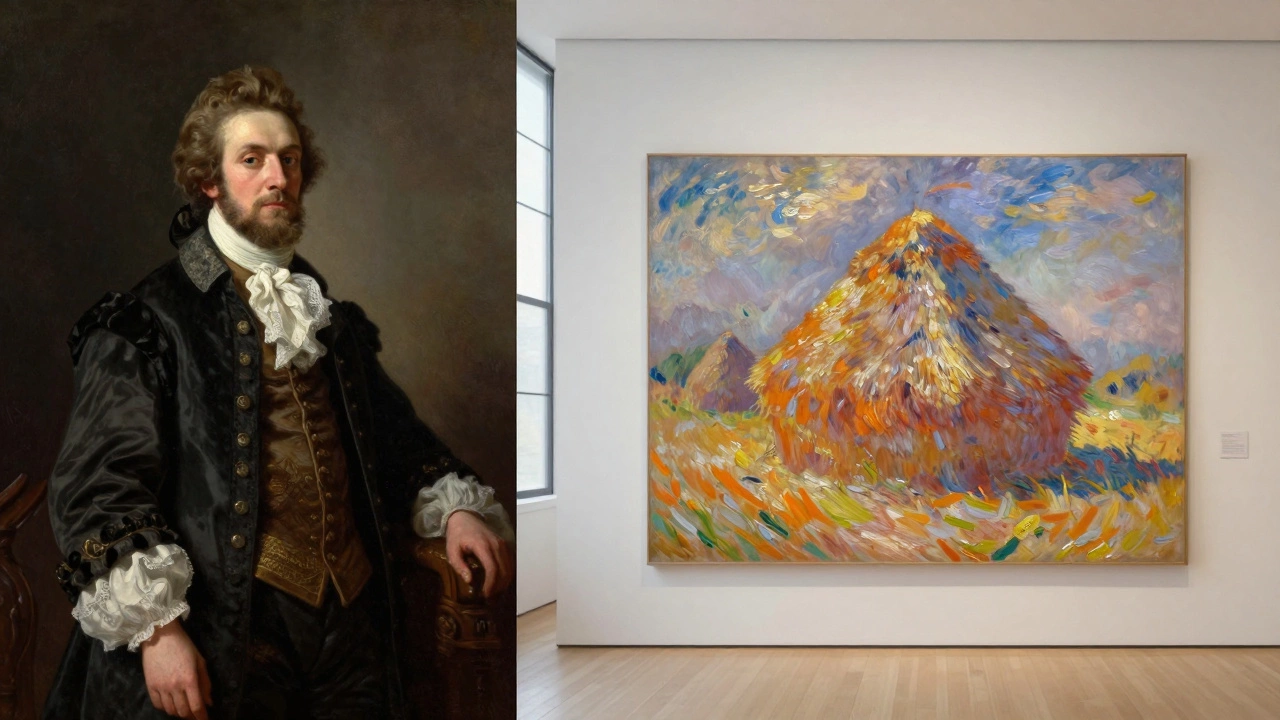
This sparked the birth of modern art principles, which prioritize expression over representation. Artists began to experiment with how to convey a feeling-like anxiety, joy, or chaos-without relying on a literal image. This is why we see the rise of Impressionism, where artists like Claude Monet focused on the fleeting quality of light and color rather than sharp outlines. They weren't painting a haystack; they were painting the experience of looking at a haystack at 4 PM in July.
The Power of Abstraction
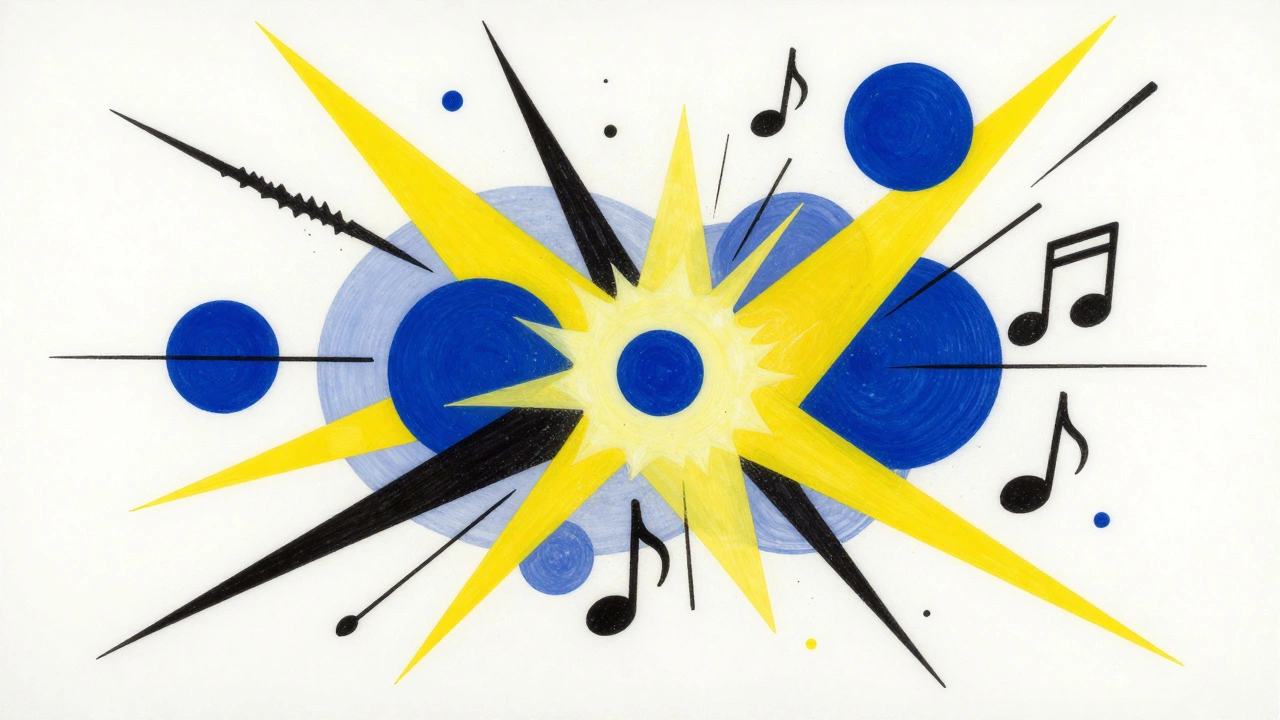
If you want to understand modern art, you have to grapple with abstraction. Abstract Art is art that does not attempt to represent an accurate depiction of a visual reality, but instead uses shapes, colors, and forms to achieve its effect. It’s a language without words. Imagine music-you don't ask a symphony "what it's a picture of"; you just feel the tension and release of the notes. Abstract artists wanted to do that with paint.
Take Wassily Kandinsky, who is often credited with creating the first purely abstract works. He believed colors had spiritual sounds. To him, a bright yellow triangle wasn't just a shape; it was a sharp, piercing sound. When you look at an abstract piece, stop asking "What is this?" and start asking "What does this color make me feel?" Does the jagged line feel aggressive? Does the soft blue circle feel calm? The principle here is the direct communication of emotion from the artist to the viewer, bypassing the need for a recognizable object.
The Role of the Avant-Garde
You'll hear the term Avant-Garde a lot. In French, it literally means "advance guard," like the soldiers who go first into battle. In art, these are the rebels. These artists didn't just want to change the style of art; they wanted to destroy the very definition of what art could be. They questioned the "sacred" nature of the museum and the gallery.
A perfect example is Marcel Duchamp and his "readymades." He took a standard porcelain urinal, signed it "R. Mutt," and called it *Fountain*. This wasn't a joke (though it felt like one); it was a philosophical attack. He was arguing that the artist's choice of an object is what makes it art, not the physical act of crafting it with a brush. This shifted the principle of art from craftsmanship to conceptualism. Suddenly, the idea became the most valuable part of the piece.
| Feature | Traditional Art | Modern Art |
|---|---|---|
| Primary Goal | Mimesis (Imitation of reality) | Expression and Exploration |
| Perspective | Linear, single-point perspective | Flat, distorted, or multi-perspective |
| Value | Technical skill and precision | Innovation and conceptual depth |
| Subject Matter | Religious, Historical, Mythological | Psychological, Everyday, Abstract |
Exploring Texture and Materiality
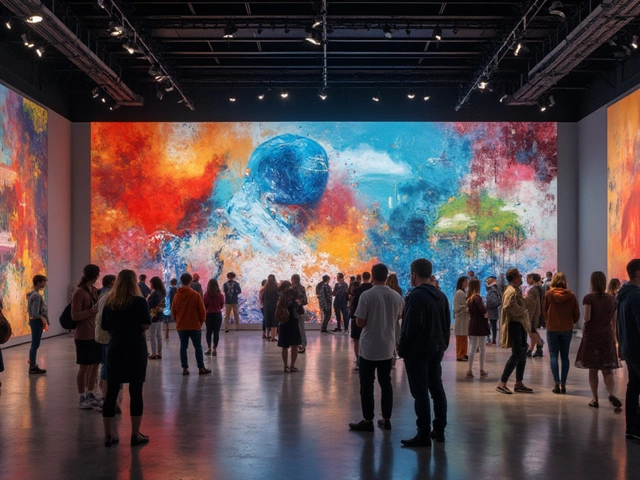
Modern art also stopped pretending that a painting was a window into another world. Instead, it acknowledged that a painting is just paint on a canvas. This is called materiality. Artists began adding sand, glass, or thick globs of paint to create 3D textures. This is especially evident in Abstract Expressionism, which is a post-WWII art movement emphasizing spontaneous, subconscious creation and gestural brushwork.
Think of Jackson Pollock. He didn't use an easel; he put his canvas on the floor and dripped paint from cans. This "action painting" turned the canvas into an arena. The painting isn't just a picture of a mood; it is the physical record of the artist's movement. The drips are the evidence of a dance. This principle tells us that the process of making the art is just as important as the final product you see hanging on the wall.
The Shift Toward Minimalism and Conceptualism
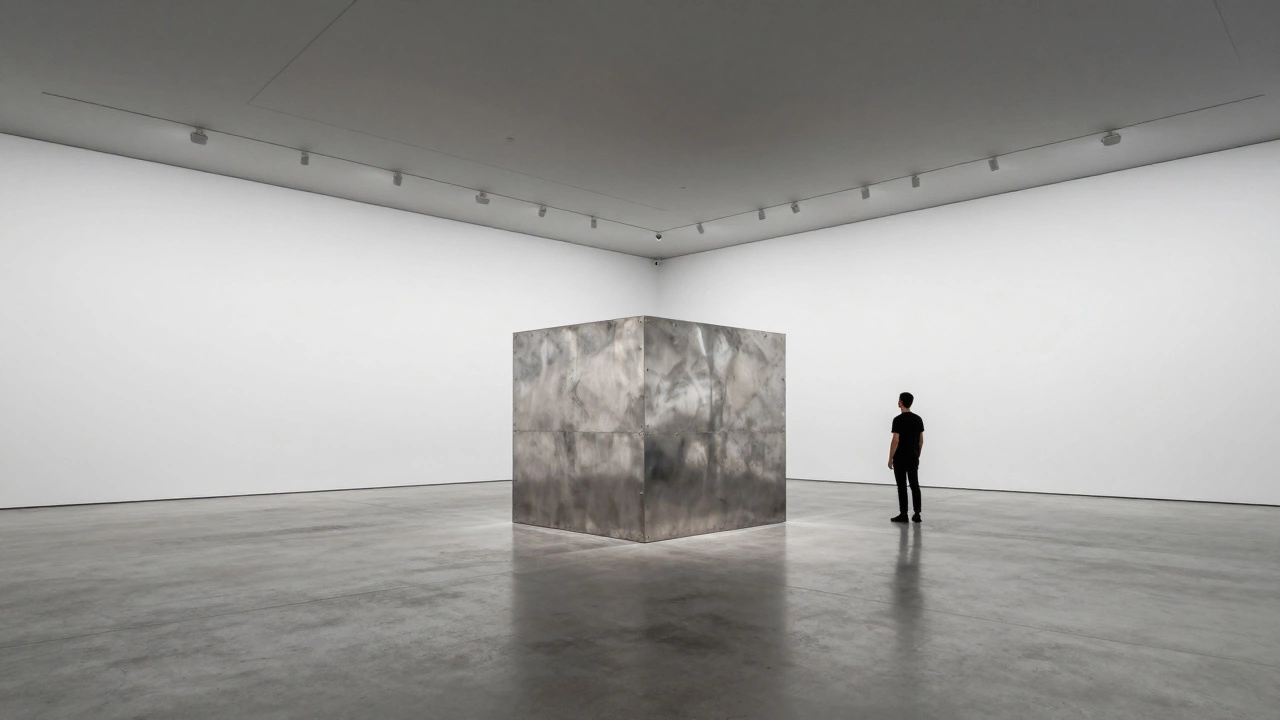
As the 20th century progressed, some artists decided that even the "emotion" of Abstract Expressionism was too much. They moved toward Minimalism. The principle here was "less is more." Minimalism strips away everything-no story, no emotion, no hidden meaning. It's just a cube of steel or a series of white stripes. The goal is to make the viewer aware of the space they are standing in and the physical presence of the object.
This eventually led to Conceptual Art, where the physical object might not even exist. The "art" could be a set of instructions on how to perform a task or a simple sentence written on a wall. Here, the principle is that art exists in the mind of the viewer. The object is merely a trigger for a thought process. If you've ever seen a blank white canvas and felt annoyed, you're actually participating in the art-your annoyance is the reaction the conceptual artist was looking for.
How to Actually "Read" a Modern Piece
Next time you're facing a piece of modern art that looks like a chaotic mess, try this approach. First, ignore the title for a second. Look at the colors. Are they clashing? Are they harmonious? Then look at the scale. Is the painting so large it swallows you, or is it tiny and intimate? Finally, consider the historical context. If it was painted in the 1940s, it might be reacting to the trauma of World War II. If it's from the 1960s, it might be mocking consumer culture.
Remember, the most important principle of modern art is that there is no "correct" way to interpret it. The artist has given up control and handed the meaning over to you. If you see a storm in a splatter of grey paint, and the artist saw a rainy Tuesday in Paris, you are both right. The meaning is created in the gap between the canvas and your eyes.
Does modern art require special training to understand?
Not at all. While knowing the history helps you understand why an artist made a choice, the core of modern art is based on personal reaction. You don't need a degree to feel a sense of dread from a dark, jagged sculpture or a sense of peace from a soft color-field painting. Your emotional response is the primary intended outcome.
What is the difference between Modern Art and Contemporary Art?
People use these terms interchangeably, but they are different. Modern art generally refers to the period from the 1860s to the 1970s (think Picasso and Dalí). It's about the break from tradition. Contemporary art refers to art made in our own time-basically from the late 20th century to today. Contemporary art often uses digital tools and focuses more on global social and political issues.
Why is some modern art so expensive if it looks simple?
The price usually isn't based on the labor or the materials, but on the "innovation." In the art market, you aren't paying for the paint; you're paying for the fact that this specific person was the first to think of this specific idea. It's like buying a piece of history. The value is in the conceptual breakthrough that changed how other artists worked.
What is a "Readymade" in modern art?
A readymade is an ordinary, manufactured object that an artist chooses and designates as art. By taking it out of its original context (like a store) and placing it in a gallery, the artist changes how we perceive it. It challenges the idea that art must be "crafted" by hand to have value.
How did Surrealism influence modern art principles?
Surrealism introduced the principle of the subconscious. Instead of painting the external world, artists like Salvador Dalí painted the internal world of dreams and desires. This validated the idea that the irrational, the weird, and the dreamlike were legitimate subjects for high art.