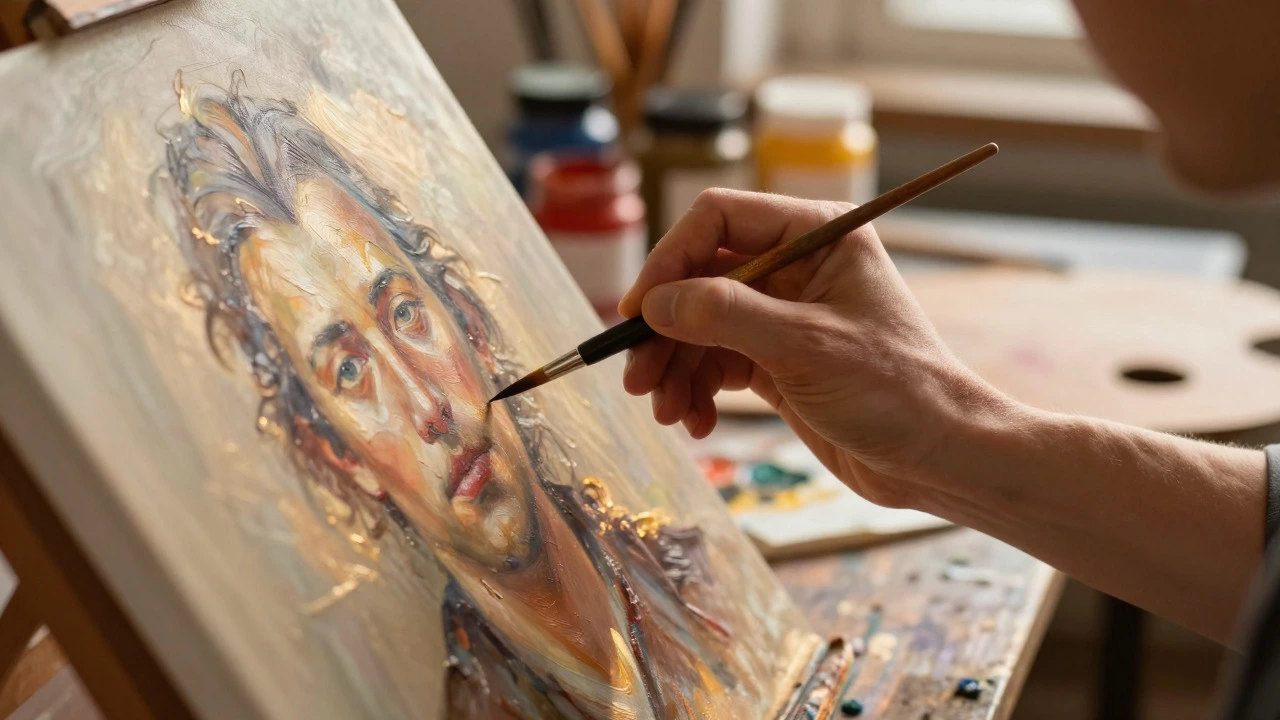
Portrait Pricing Calculator
Estimated Portrait Price
Fair Market ValueYou have the talent. You have the time. But when a potential client asks, "How much for a portrait?" your mind goes blank. Do you charge $50 and feel ripped off? Or do you quote $2,000 and watch them walk away? Pricing is the single biggest hurdle for artists moving from hobbyists to professionals.
There is no magic number that works for everyone. A good price depends on your experience, the materials used, the size of the canvas, and the emotional value you provide. However, there are proven formulas and industry standards that can help you calculate a rate that respects your labor while remaining competitive in the market.
The Core Problem: Why Art Pricing Is Hard
Unlike selling widgets, art has no fixed manufacturing cost that dictates its final value. If you buy a canvas for $10 and paint it for five hours, does it sell for $60? Probably not. The market doesn't always pay for your time; it pays for the result, the reputation, and the scarcity.
Many new artists make the mistake of underpricing because they are afraid of rejection. This leads to burnout. Others overprice based on ego rather than market reality, resulting in zero sales. Finding the "good price" means finding the intersection between your worth and what the customer is willing to pay.
Method 1: The Hourly Wage Plus Materials Formula
This is the most straightforward method, especially for beginners who need to ensure they are at least breaking even. It treats art like any other skilled trade.
- Determine your hourly rate: Decide what you want to earn per hour. If you aim for a modest $25/hour, start there. As you gain clients, increase this to $50, $75, or more.
- Track your time accurately: Use a timer. Note every minute spent sketching, mixing colors, painting, and even cleaning brushes. Let's say a portrait takes 10 hours.
- Calculate labor cost: 10 hours x $25 = $250.
- Add material costs: Canvas, paints, varnish, frame (if included). Let's say these total $40.
- Total Base Price: $250 + $40 = $290.
Pro Tip: Many artists double this final number to account for non-billable hours (marketing, invoicing, studio rent) and profit margin. So, a $290 base might become a $580 asking price. This ensures that if you spend two hours emailing clients for one sale, you still come out ahead.
Method 2: The Square Inch Formula
This method is popular among established painters because it scales with the size of the work. It removes the variable of how fast you paint. A large piece commands more money simply due to its physical presence and material usage.
The formula is simple: Price = Width (inches) x Height (inches) x Dollar Amount Per Square Inch.
What should your dollar amount be? This varies wildly by region and expertise.
- Beginner/Local Market: $0.50 - $1.00 per square inch.
- Intermediate/Regional: $1.50 - $3.00 per square inch.
- Professional/National: $4.00 - $10.00+ per square inch.
Example Calculation: You are painting a 16x20 inch portrait.
- Area: 16 x 20 = 320 square inches.
- Rate: $2.00 per square inch (intermediate level).
- Price: 320 x $2.00 = $640.
This method prevents you from undercharging for massive canvases where the material cost and visual impact are high.
Key Factors That Influence Portrait Value
Beyond the math, several qualitative factors shift the price up or down. Understanding these helps you justify your quotes to clients.
| Factor | Impact on Price | Reasoning |
|---|---|---|
| Complexity | High | A full-body scene with pets, background landscapes, and multiple subjects requires significantly more skill and time than a head-and-shoulders bust. |
| Medium | Variable | Oil paintings often command higher prices than acrylics or watercolors due to perceived prestige and longevity, though digital portraits may be priced lower due to reproducibility. |
| Reputation | High | If you have gallery representation, awards, or a strong social media following, your "brand" adds value independent of the labor. |
| Usage Rights | Critical | Is the portrait for personal home display or commercial use (e.g., on a website, packaging)? Commercial licenses require a significant premium. |
| Turnaround Time | Moderate | Rush jobs (under 2 weeks) should incur a 20-50% surcharge to compensate for prioritizing this client over others. |
Understanding Client Expectations
Not all clients are created equal. A grandmother wanting a gift for her grandson has a different budget than a corporation wanting a CEO’s likeness for their lobby.
Personal Commissions: These clients are often price-sensitive but emotionally driven. They want a keepsake. Here, offering tiers helps.
- Basic Tier: Small size, limited revisions, digital proof only. ($300-$500)
- Standard Tier: Medium size, one revision round, physical print shipped. ($600-$900)
- Premium Tier: Large size, unlimited minor tweaks, framed, signed certificate of authenticity. ($1,200+)
Commercial Commissions: Businesses view art as an investment. They expect professionalism, contracts, and clear licensing terms. Never sell a commercial portrait for less than $1,500 unless you are just starting. Always specify that the client buys the physical object, but you retain the copyright unless a separate fee is paid for full transfer.
Common Pricing Mistakes to Avoid
1. Giving Free Revisions: Clients will ask for changes. "Can you make the eyes bluer?" "Can we add a dog?" Limit your contract to two rounds of minor revisions. Charge extra for major structural changes after the initial sketch approval.
2. Ignoring Overhead: Your price must cover more than paint. It must cover your internet bill, software subscriptions (like Adobe Creative Cloud), portfolio website hosting, and marketing ads. Add a 10-15% overhead buffer to your calculations.
3. Discounting Too Early: If someone says, "It's too expensive," don't immediately drop the price. Ask, "What was your budget?" Sometimes they just need payment plans. Dropping the price devalues your work instantly.
How to Present Your Price
Confidence is key. When quoting, avoid apologetic language like, "I think maybe..." or "If that's okay with you..." Instead, use direct statements:
- "The investment for this 16x20 oil portrait is $800."
- "This includes the original painting, shipping, and a printed certificate of authenticity."
Provide a clear breakdown in your proposal. Show them the value: materials, hours, expertise, and rights. Transparency builds trust.
Setting Up a Pricing Structure for 2026
In today's market, transparency is appreciated. Consider publishing a "Starting At" price on your website or Instagram bio. For example, "Portraits starting at $400." This filters out tire-kickers and attracts serious buyers. Update these prices annually to match inflation and your growing skill set.
How much should I charge for my first portrait?
For your first few commissions, focus on building your portfolio rather than maximizing profit. Charge enough to cover materials and a modest hourly wage (e.g., $15-$20/hour). A reasonable starting price for a small-to-medium portrait could be $150-$300. Clearly state that this is a "portfolio-building rate" so future clients understand your prices will rise.
Should I include framing in the price?
It is best to list the price of the artwork separately from framing. Framing costs vary wildly by location and style. Offer to source a frame for an additional fee, including the cost of the frame plus a markup for your time coordinating it. This gives the client flexibility and protects you from unexpected shipping damage to fragile frames.
Do I need a contract for portrait commissions?
Yes, absolutely. A contract protects both you and the client. It should outline the scope of work, timeline, number of revisions allowed, payment schedule (typically 50% upfront, 50% upon completion), and copyright ownership. Even a simple email agreement serves as a binding contract in many jurisdictions.
How do I handle refunds if the client hates the portrait?
Art is subjective. To mitigate this, require client approval at key stages: first the sketch, then the color block-in, then the final details. Once the sketch is approved, the client is committed. In your contract, specify that refunds are only given if the artist fails to deliver the agreed-upon specifications. If the client simply changes their mind, the deposit is non-refundable, though you may offer to keep the piece for resale.
Is digital portrait pricing different from traditional painting?
Yes, digital portraits are often priced lower than traditional paintings because they lack physical scarcity and material costs. However, if the client wants high-resolution files for commercial use, the price should increase significantly. A personal-use digital portrait might range from $100-$300, while a commercial license could push that to $1,000+. Always clarify file resolution and usage rights.