Find Your Perfect Printing Method
Not sure if you should choose Giclée, Dye-Sub, or Screen Printing? This tool analyzes your project goals to recommend the ideal production method.
Project Parameters
You have spent months perfecting a piece, and now you face the next big hurdle: how do you put that image on paper so people can buy it? Choosing the wrong process is like framing a Monet with bubblegum tape-it ruins the illusion. There isn't one single "best" method for every situation, but there is a clear winner for professional galleries, and very different contenders for high-volume merch.
The short answer for most serious artists is Giclée printing is the industry standard for fine art reproduction. However, understanding why requires looking at the ink chemistry, the substrate, and the intended lifespan of the artwork.
Why Giclée Is the Gold Standard for Serious Art
If you walk into a commercial gallery today, ninety percent of the works on paper are likely produced via this method. It stands out because it treats every print as a unique artifact rather than a mass-produced copy. The term comes from the French word "gicleur," meaning to spray or squirt, referring to the way piezoelectric technology deposits microscopic droplets of ink onto the surface.
The real magic lies in the materials used. Most home printers use dye-based inks which fade quickly under sunlight. In contrast, professional Pigment Inka stable compound suspended in liquid carrier that bonds chemically with fibers rather than sitting on top. This distinction matters immensely for collectors worried about their investment losing color over time.
When you choose this route, you also gain control over the substrate. You aren't stuck with glossy photo paper. You can print on textured cotton rag, watercolor board, or even metallic sheets. The printer creates a "profile" for that specific paper type to ensure the reds look deep and the blacks remain neutral gray, not muddy purple. This level of calibration is what separates a $50 print from a $500 limited edition.
Dye-Sublimation: The High-Volume Alternative
If your goal is t-shirts, mugs, or large-scale banners where color vibrancy matters more than century-long archival stability, then Dye Sublimationa heat transfer technique that turns solid dye directly into gas to bond with synthetic polymers. becomes relevant. This process doesn't sit well with natural materials like cotton or linen, but it dominates the polyester and plastic market.
The advantage here is speed and saturation. Because the dye actually penetrates the material, you don't get that cracked texture you often see with thick layers of plastisol ink. If you are selling merchandise at conventions or online stores, this allows you to run thousands of units without worrying about individual registration errors common in screen printing.
However, you cannot ignore the limitations. Dye-sub prints generally have a smaller gamut when it comes to matte finishes. They often lack the deep shadow detail that pigment inks provide on white paper. For a portrait photographer who needs crisp skin tones, dye-sub might wash out the details in the dark areas of the hair or eyes. It's excellent for bright pop-art style graphics but risky for subtle grayscale photography.
Lithography and Serigraphy: The Mechanical Arts
Sometimes, the question isn't about digital reproduction but about creating original multiples using physical matrices. Lithographya planographic printing method using grease and water separation chemistry on stone or metal plates. remains a respected medium for contemporary illustrators who prefer hand-drawn textures over flat digital scans.
In lithography, the artist draws directly onto the plate using special crayons or fluids. When rolled through a press, the resulting image has a slight tactile variation in density that mimics human touch. Unlike digital methods where every dot is identical, lithography has grain. The imperfection is the feature.
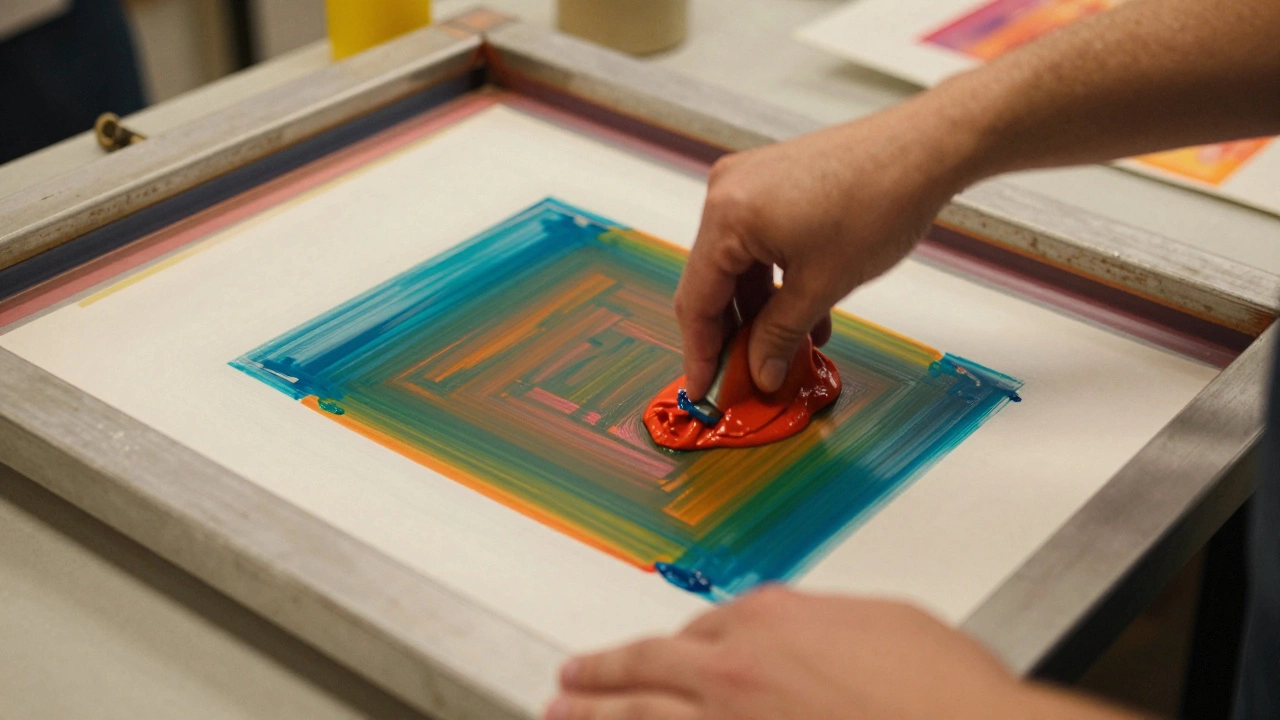
Similarly, Screen Printinga stencil-based process pushing paste through a mesh screen to create bold, layered colors. offers a heavy opacity that flat paper printing rarely achieves. Pop art legends like Warhol relied on the ability to layer neon inks transparently. If you are working with graphic designers or street artists, screen printing adds a physical weight to the paper. The paint sits on top of the fibers rather than soaking in, giving a slightly raised texture collectors love to feel.
The Critical Role of Archival Materials
No matter which machine you feed the file into, the lifespan of the print is dictated by what you print on. Many low-quality labs use acid-coated wood pulp paper. Acid degrades cellulose, turning the paper yellow and brittle within decades. To guarantee preservation, you must insist on Cotton Rag Paperpaper made from 100% cotton fibers, free from acid and lignin.
This material is essentially linen fabric pulped down into sheets. It is expensive, yes. But if you are selling "Limited Editions" of 50 copies, buying cheap paper undermines the premise. Buyers expect these to last a lifetime. Using Acid-Free Papermaterial treated to maintain a neutral pH balance preventing chemical breakdown ensures the support won't eat away at the ink over centuries.
Beyond paper, consider the mounting. Acrylic plexiglass protectors should ideally be UV-filtered. Even the best pigment ink will bleach if exposed to direct, unfiltered sunlight for years. The "best" print is useless if it vanishes because the buyer hung it in a window box. Always guide clients toward UV Protection Glazingspecialized glass or acrylic coatings blocking harmful ultraviolet light rays.
Managing Color Accuracy and Gamut
A frequent point of confusion involves color profiles. Your monitor lies to you. Most displays operate in RGB (Red, Green, Blue) while printers use CMYK (Cyan, Magenta, Yellow, Key/Black) plus extra inks for rich blacks or extended ranges. The "gamut" is the range of possible colors.
Professional labs handle this through RIP SoftwareRaster Image Processors that translate pixel data into precise ink droplet patterns. Good software simulates exactly what will happen on the final paper before you commit. For instance, certain papers absorb magenta differently than others. A calibrated workflow prevents that "off-white" cast often found in amateur prints.
Look for certification. Standards like ISO 12647an international standard for prepress production ensuring consistent color across different devices and locations. indicate a lab knows how to manage color science. Without this, every print sent to a different printer looks slightly different, ruining the consistency of a numbered series.
How do I tell if a Giclée print is authentic?
Authentic Giclée prints always come from a professional archive-capable studio using Epson or Canon grand format printers with pigment inks. Ask for a Certificate of Authenticity that includes the printer model, paper type used, and whether archival lamination was applied. If they cannot specify the materials, it is likely a standard photo print labeled as Giclée.
Are digital prints considered "originals"?
Not in the traditional sense. An original implies the first pass through the matrix (like a painting). Digital reproductions are considered limited edition prints. Their value depends on scarcity-once you state "Edition of 50" and sign/number them properly, they hold secondary market value.
Which paper lasts longer: coated or uncoated?
Generally, coated papers offer better lightfastness ratings because the coating protects the pigment from oxidation. However, high-quality uncoated cotton rag is naturally durable due to its dense fiber structure. Avoid wood pulp entirely if longevity is your priority.
Is there a cost difference between Giclée and Offset?
Yes, significant. Giclée has low setup costs but higher per-unit costs. Offset printing (used for magazines/posters) requires expensive plates, making it cheaper only when ordering massive runs (1,000+). For small batches, offset is prohibitively expensive.
Can I frame a Giclée under glass?
You can, though many artists prefer floating frames to avoid condensation issues. If glazing is required, ensure there is a mat spacer so the glass does not touch the printed surface. Moisture trapped between paper and glass causes mold growth over time.