Modernism Art Identifier Tool
Describe the Artwork
Answer these two questions to determine if the artwork leans towards Modernism.
Analysis Result
Select your options and click Analyze to see if the work fits the Modernist profile.
Walk into any major museum today, and you will likely find a painting that looks like a child’s finger painting or a sculpture made from scrap metal. If you grew up thinking art should look like the polished portraits in history books, these pieces can be confusing. They feel wrong. They break the rules. But that is exactly the point.
Many people ask me what makes modernism art so different from everything that came before it. The answer isn’t one single trick or style. It comes down to two massive shifts in how artists thought about their work. First, they stopped trying to copy reality perfectly. Second, they started caring more about the materials and the process than the final image. These two changes shook the art world apart and built something new.
Breaking the Mirror: Rejecting Realistic Representation
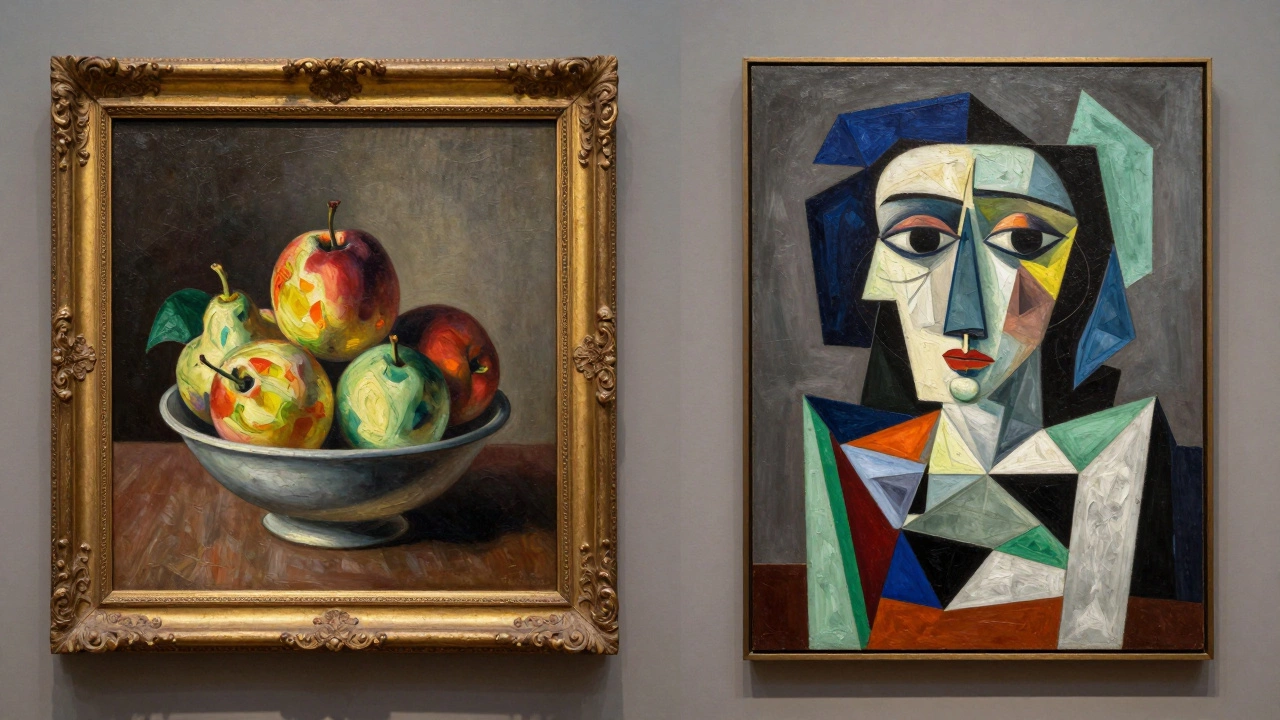
For thousands of years, the goal of Western art was representation. Artists wanted to create a window into the real world. If you painted a bowl of fruit, you wanted it to look so real that you could almost smell the apples. This tradition relied on techniques like linear perspective, realistic lighting, and accurate anatomy. It was about skill in imitation.
Then came the camera. Invented in the early 19th century, photography quickly became better at capturing reality than any painter ever could. Why spend three months painting a portrait when you could click a button and get a perfect likeness in seconds? This forced artists to ask a big question: What is left for us to do?
The answer was to stop copying the outside world and start showing the inside world. This is the first main characteristic of modernism: the move away from realistic representation toward abstraction and subjective experience.
Picasso didn’t want to show you what a guitar looked like from one spot. He wanted to show you the idea of the guitar-its front, back, and sides all at the same time. This approach stripped art down to its essential forms. It prioritized structure over surface appearance.
You see this shift everywhere in modernism. Wassily Kandinsky moved further still, abandoning recognizable objects entirely. His paintings were pure color and shape, designed to evoke emotions similar to how music does. There was no "real" thing to look at, only feelings and rhythms. This marked a complete break from the mirror-like tradition of the past. Art was no longer about what you saw; it was about what you felt.
Focusing on the Medium: Form Over Function
If the first change was about what artists depicted, the second change was about how they made it. Before modernism, the materials used in art were often hidden. Painters tried to make canvas look like skin or stone. Sculptors chipped away marble to make it look like soft flesh. The goal was to hide the effort and the material.
Modernists flipped this script. They celebrated the materials themselves. This is the second main characteristic of modernism: an emphasis on the medium and the process of creation. Artists began to highlight the flatness of the canvas, the texture of the paint, and the raw nature of industrial materials.
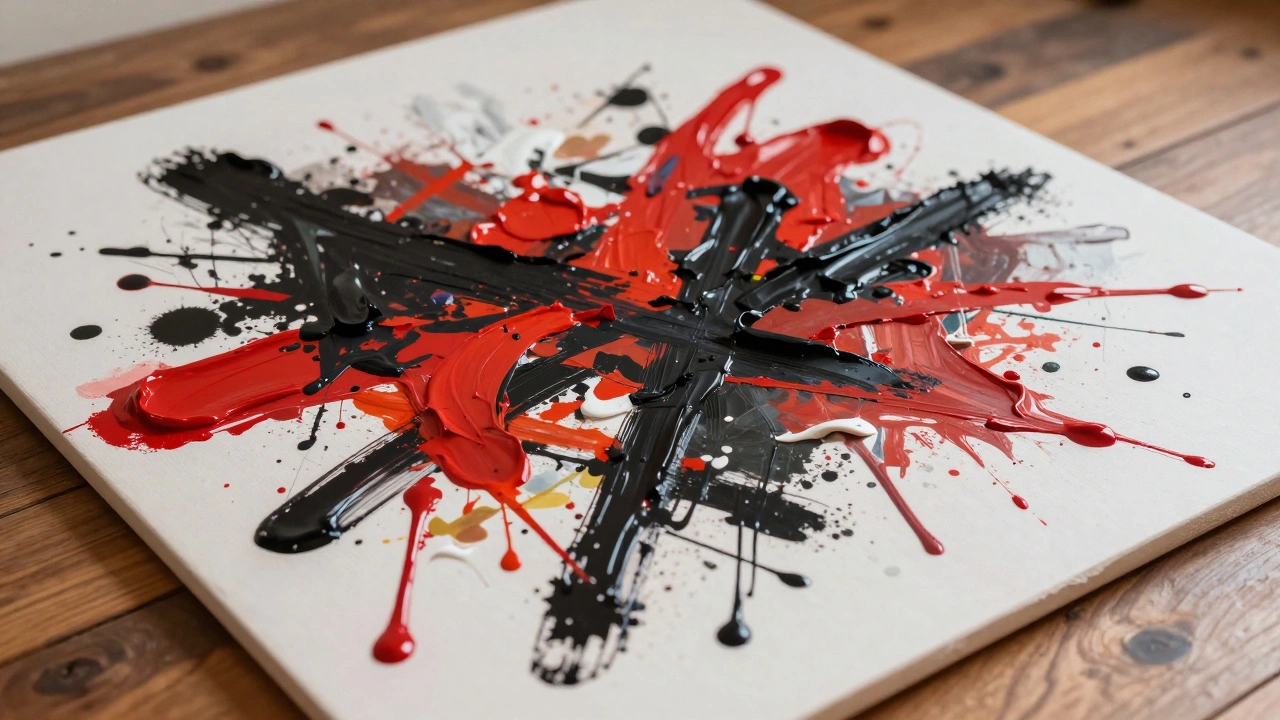
Consider the work of Jackson Pollock. He didn’t sit at an easel with a brush. He put huge canvases on the floor and dripped, splashed, and poured paint onto them. You can see every movement of his body in the layers of paint. The artwork is a record of the action itself. The "image" matters less than the energy captured in the gesture. This is called Abstract Expressionism, and it puts the physical act of making art center stage.
This focus on material also led to the rise of ready-mades. Marcel Duchamp famously took a urinal, signed it, and called it art. By doing so, he argued that the context and the artist’s choice mattered more than the craftsmanship. The object itself-the medium-was the statement. This challenged the very definition of what art could be.
| Feature | Traditional Art (Pre-1860s) | Modernist Art (1860s-1970s) |
|---|---|---|
| Goal | Imitate reality accurately | Express inner truth or explore form |
| Perspective | Single, fixed viewpoint | Multiple viewpoints or none at all |
| Materials | Hidden to create illusion | Highlighted for texture and presence |
| Subject Matter | Religious, historical, mythological | Everyday life, abstract concepts, self |
| Viewer Role | Passive observer of a scene | Active participant interpreting meaning |
This table shows the stark contrast. Modernism didn’t just change styles; it changed the contract between the artist and the viewer. You are no longer being told a story. You are being invited to engage with a visual problem.
Why Did This Happen? Context Matters
You cannot understand these two characteristics without understanding the world that created them. Modernism emerged during a period of massive upheaval. The Industrial Revolution changed how people worked and lived. Cities grew crowded and noisy. New technologies like electricity and film altered human perception.
Then came World War I. The sheer scale of destruction shattered faith in old institutions, including religion and monarchy. If the old ways had led to such horror, why follow their rules in art? Artists needed a new language for a new, fractured world. Realism felt dishonest because it ignored the chaos underneath the surface. Abstraction allowed them to express anxiety, speed, and fragmentation.
Think about it. A smooth, realistic portrait of a king feels out of place after the trenches of WWI. But a jagged, disjointed collage reflects the broken state of society. The characteristics of modernism weren’t just aesthetic choices; they were responses to history.
Common Misconceptions About Modernism
Even today, many people misunderstand modernism. Here are three common myths I hear often:
- "My kid could do that." This is the most frequent complaint. While it may look simple, executing a balanced composition with limited colors requires immense discipline. Removing detail is harder than adding it. You have to decide what is essential and what is noise.
- "It’s not art because it doesn’t look like anything." This assumes art must represent physical objects. Music doesn’t look like anything, yet we value it. Modernist art operates similarly, using visual elements to create emotional resonance rather than visual recognition.
- "Modernism is the same as Contemporary Art." They are not. Modernism generally refers to the period from the late 19th century to the 1970s. Contemporary art refers to art made today. While contemporary artists use modernist tools, they often critique or reject modernist ideals.
Understanding these distinctions helps you appreciate the work. When you look at a Mark Rothko color field painting, you aren’t supposed to find a hidden picture. You are supposed to stand close and let the colors wash over you. The large scale and soft edges are designed to immerse you. That is the power of focusing on the medium.

How to Spot Modernism in a Gallery
Next time you visit a gallery, try this simple test. Look at a piece and ask yourself two questions:
- Does this try to hide the fact that it is made of paint, stone, or metal? If no, it leans modernist.
- Does this show me a clear, single view of a person or place? If no, it leans modernist.
If both answers are "no," you are likely looking at modernism. For example, a sculpture by Constantin Brâncusi that simplifies a bird into a smooth, elongated shape focuses on the essence of flight rather than feathers and claws. It celebrates the bronze material itself. It rejects realistic detail.
This mindset applies to architecture too. Modernist buildings, like those by Le Corbusier, feature clean lines, open plans, and exposed structural elements. They don’t have ornate columns pretending to be trees. They are honest about being made of concrete and steel. This honesty is a direct result of the second characteristic: respect for the medium.
The Legacy of Modernism Today
Modernism didn’t end; it evolved. Its influence is everywhere. Think about the design of your smartphone. It has a flat screen, minimal buttons, and clean typography. That is modernist design. It prioritizes function and simplicity over decoration.
In art education, students still learn about composition, color theory, and negative space-tools developed and refined by modernists. Even artists who rebel against modernism are reacting to its legacy. You can’t ignore a giant that shaped the last century.
By understanding these two core traits-rejecting strict realism and embracing the material-you gain a key to unlock some of the most challenging works in history. You stop asking, "What is it?" and start asking, "How does it work?" That shift in perspective is where the real enjoyment begins.
When did modernism art start?
Modernism is generally considered to have begun in the late 19th century, around the 1860s to 1880s. Movements like Impressionism are often seen as the starting point, followed by Post-Impressionism, Fauvism, and Cubism in the early 20th century.
Is modernism the same as contemporary art?
No. Modernism refers to a specific historical period roughly from the 1860s to the 1970s. Contemporary art refers to art produced from the late 20th century to the present day. While contemporary art builds on modernist ideas, it often includes different themes, technologies, and global perspectives.
Who are the most famous modernist artists?
Key figures include Pablo Picasso (Cubism), Vincent van Gogh (Post-Impressionism), Wassily Kandinsky (Abstract Art), Jackson Pollock (Abstract Expressionism), and Marcel Duchamp (Dada). Each contributed significantly to breaking traditional rules.
Why did modernist artists stop painting realistically?
The invention of photography reduced the need for realistic depiction. Additionally, social upheavals like wars and industrialization made traditional realistic art feel inadequate for expressing the complexity and trauma of modern life. Artists sought new ways to convey emotion and inner experience.
What is the difference between abstract art and modernism?
Abstract art is a style within modernism. Not all modernist art is abstract (some is semi-abstract or stylized realism), but abstraction is a major component of the movement. Modernism is the broader philosophical and historical framework that encouraged experimentation, including abstraction.